How Metering Microcontrollers Support Faster Data Processing in Next-Generation Smart Meters
How Metering Microcontrollers Support Faster Data Processing in Next-Generation Smart Meters
Next-generation smart meters are evolving from simple electricity measurement devices into intelligent edge terminals capable of processing multiple electrical parameters, managing communication, storing event data, and supporting increasingly complex utility functions. As these requirements grow, the performance of the metering microcontroller becomes more important to the overall meter architecture.
For smart meter manufacturers, engineering teams, and procurement managers, selecting the right metering microcontroller is no longer only about processing speed. Computing capability, peripheral integration, memory resources, power consumption, communication support, reliability, and long-term supply stability can all affect development time and total product cost. A suitable microcontroller can help manufacturers process metering data faster while simplifying the hardware platform and supporting future product upgrades.
1. Why Faster Data Processing Is Becoming Essential in Modern Smart Meters
Traditional electricity meters mainly focused on measuring energy consumption and displaying basic information. Modern smart meters are expected to perform significantly more functions within the same device.
Depending on the application, the meter may need to process voltage, current, active power, reactive power, power factor, frequency, tariff information, load profiles, alarms, communication commands, and historical data. Many systems also require real-time monitoring of abnormal events such as overvoltage, overload, reverse energy flow, or unexpected load changes.
These additional functions create higher processing requirements. The microcontroller must collect measurement data, perform calculations, manage memory, control the LCD, communicate with external devices, and respond to system events without creating excessive delays.
Faster processing can support several important smart meter functions:
Real-time electrical parameter calculation
Faster event detection and response
More detailed load profile recording
Multi-tariff data management
Communication protocol processing
Display and user interface control
Data encryption and system security functions
For OEM manufacturers, processing performance can also influence future product scalability. A microcontroller that operates close to its performance limit during the first product generation may create difficulties when new communication features, additional monitoring functions, or firmware upgrades are introduced later.
Procurement teams should therefore consider not only the immediate technical requirement but also the expected development roadmap of the meter platform.
2. How Microcontroller Architecture Can Simplify Smart Meter Hardware and Software Design
A modern metering microcontroller can provide more value than raw computing speed. Integrated peripherals, memory resources, communication interfaces, timers, analog functions, and security features can reduce the number of additional components required on the PCB.
This can simplify both hardware and software development.
Higher Processing Capability:
More computing resources allow the meter to process multiple measurement channels and communication tasks while maintaining responsive system operation.
Integrated Communication Interfaces:
Smart meters may require UART, SPI, I²C, or other interfaces to communicate with metering ICs, displays, memory devices, communication modules, or external controllers. Integrated interfaces can simplify PCB design and reduce additional circuitry.
Flexible Memory Resources:
Flash and RAM capacity influence how much firmware, event data, calibration information, and communication functionality can be supported. Sufficient memory also provides additional space for future software upgrades.
Peripheral Integration:
Timers, watchdogs, GPIO resources, and other built-in peripherals can reduce the number of external components and help simplify the meter architecture.
Lower System Complexity:
Reducing external components can decrease PCB area, simplify procurement, shorten assembly time, and lower the number of potential failure points.
For high-volume meter manufacturers, these advantages can have a direct financial impact. Even a small reduction in PCB components or assembly operations can create meaningful cost savings when production volumes reach hundreds of thousands or millions of units.
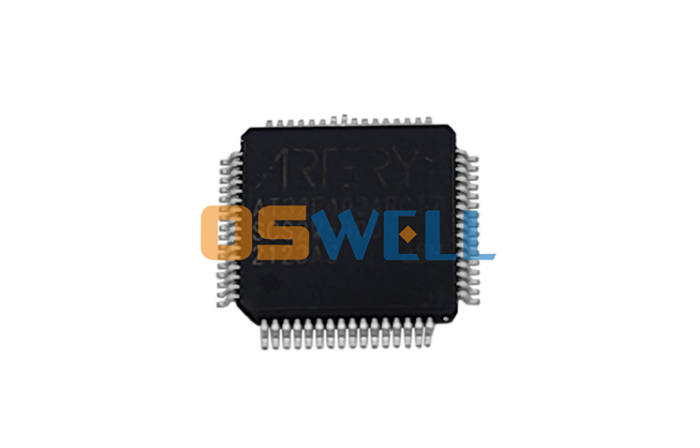
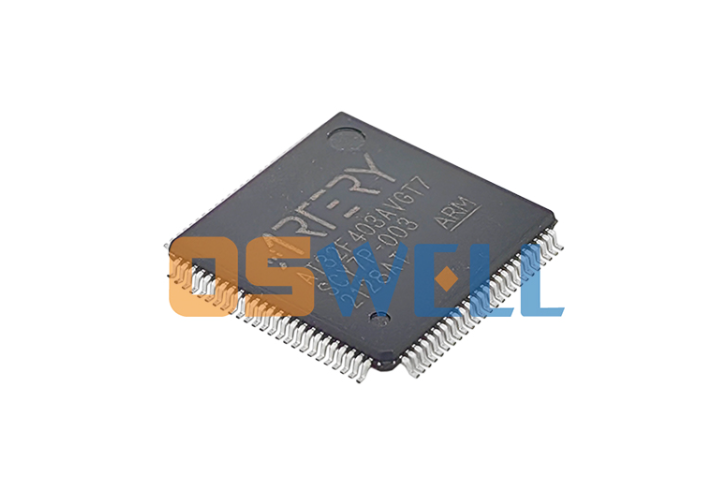
Microcontrollers used for metering applications, such as the AT32F403 series available within OSWELL's metering component portfolio, can be evaluated as part of a complete smart meter control platform. The final selection should consider CPU performance, memory capacity, interface requirements, firmware complexity, and compatibility with other metering components.
3. What Procurement Teams Should Evaluate When Selecting Metering Microcontrollers
Selecting a microcontroller for a smart meter is a long-term platform decision. Once the MCU has been integrated into the PCB, firmware, production programming process, testing system, and certification workflow, changing the device can require significant engineering resources.
For this reason, procurement teams should evaluate both the technical specifications and the long-term supplier strategy.
Important factors include:
Processor performance and clock capability
Flash and RAM capacity
Available communication interfaces
Peripheral integration
Operating temperature range
Power consumption
Package and PCB compatibility
Firmware development support
Long-term product availability
Supply consistency for mass production
Procurement managers should also work closely with firmware and hardware engineers before approving a device. A microcontroller with a lower initial price may create additional costs if it requires external memory, extra interface components, or more complicated firmware optimization.
Development ecosystem is another important consideration. Documentation, debugging tools, software libraries, technical support, and sample availability can influence how quickly the engineering team moves from prototype to production.
For high-volume OEM programs, supply stability is equally important. Smart meter projects often continue for many years, and component shortages or sudden product changes can create expensive redesign work. Buyers should therefore consider supplier capacity, product lifecycle planning, and alternative sourcing strategies during the qualification stage.
A suitable metering microcontroller should provide enough performance for current requirements while maintaining additional resources for future firmware updates and new functions. This helps manufacturers build a more flexible meter platform instead of redesigning the core electronics whenever market requirements change.
Conclusion
Metering microcontrollers are becoming increasingly important as smart meters take on more measurement, communication, monitoring, and data-processing functions. Faster processing, integrated peripherals, sufficient memory, and flexible communication interfaces can help manufacturers simplify hardware design while supporting more advanced meter functionality. For procurement teams, the best microcontroller choice should balance technical performance with development support, total system cost, mass-production consistency, and long-term supply availability. By selecting a suitable metering MCU early in the product development process, smart meter manufacturers can reduce redesign risks, improve production efficiency, and build a more scalable platform for the next generation of intelligent energy measurement products.