How Type 2 AC Charging Connector Design Affects Contact Temperature and Insertion Life
How Type 2 AC Charging Connector Design Affects Contact Temperature and Insertion Life
Type 2 AC charging connectors are widely used in residential, workplace, destination, and commercial EV charging applications. Although the connector may appear to be a relatively simple mechanical interface, its internal design directly influences electrical resistance, contact temperature, insertion force, mechanical wear, and long-term charging reliability. For EVSE manufacturers, charging cable suppliers, distributors, and procurement teams, selecting a Type 2 connector should therefore involve much more than confirming current rating and plug compatibility. Contact structure, terminal material, spring force, housing design, thermal performance, and production consistency all affect the service life of the complete charging system.
1. Contact Resistance Is the Starting Point for Temperature Control
Every charging connector creates an electrical interface between the EV charging cable and the vehicle inlet. When current flows through this interface, even a small amount of resistance produces heat. As charging current increases, controlling contact resistance becomes increasingly important.
Contact resistance is influenced by several factors, including contact material, surface condition, contact pressure, terminal geometry, insertion accuracy, and manufacturing tolerances. If any of these factors are poorly controlled, the connector may develop localized hot spots during continuous charging.
Electrical contact resistance
Contact material and surface treatment
Terminal crimping quality
Contact pressure stability
Conductor cross-sectional area
Connector housing thermal behavior
For AC charging applications, the connector may remain under load for several hours. This means thermal performance should be evaluated under sustained current rather than only during short-duration electrical tests.
Excessive temperature can accelerate the aging of plastic housings, insulation, seals, terminals, and nearby cable materials. It can also increase electrical resistance further, creating a negative cycle where rising resistance generates additional heat.
Procurement teams should therefore request temperature-rise data and evaluate the complete connector assembly, including the terminal, cable, and contact interface. A connector that performs well only under ideal laboratory conditions may not provide the same reliability after repeated use, environmental exposure, and long charging sessions.
2. Insertion Life Depends on Mechanical Precision, Contact Force and Material Durability
A Type 2 charging connector may be inserted and removed thousands of times during its service life. Every cycle creates mechanical friction and stress on the contact surfaces, locking structure, housing, seals, and cable entry point. If the design does not control these forces effectively, insertion resistance may increase or electrical contact quality may deteriorate over time.
Contact pressure is especially important. The connector needs enough force to maintain a stable electrical interface, but excessive force can increase wear and make the connector difficult for users to insert or remove.
Helps maintain electrical contact while avoiding excessive insertion resistance and mechanical wear.
Consistent connector geometry supports reliable mating and reduces uneven contact stress.
Suitable conductive and housing materials help maintain performance through repeated use.
Reduces mechanical stress where the charging cable enters the connector body.
Environmental exposure also affects insertion life. Outdoor charging connectors may encounter dust, moisture, temperature changes, road contaminants, and repeated handling. These conditions can influence seals, contact surfaces, and housing materials.
OEM buyers should therefore look beyond a single insertion-cycle specification. They should consider whether the connector maintains acceptable contact resistance, insertion force, locking performance, and temperature behavior after repeated cycling.
A reliable Type 2 connector should provide a balance between user-friendly operation and stable electrical contact throughout its expected service life.
3. What Procurement Teams Should Evaluate Before Approving a Type 2 Connector Supplier
For charging equipment manufacturers, a connector is part of the complete electrical and mechanical system. Once the connector has been matched to the cable, charger enclosure, strain relief, wiring structure, and production process, changing suppliers later can require additional testing and validation.
Procurement teams should therefore evaluate both connector design and supplier manufacturing capability before moving into high-volume production.
Rated current capability
Contact resistance
Temperature-rise performance
Insertion and withdrawal force
Insertion cycle durability
Terminal material quality
Housing mechanical strength
Strain-relief design
Production traceability
Batch-to-batch consistency
Buyers should request samples from multiple batches and test them with the actual charging cable and EVSE configuration. Evaluation can include continuous current loading, repeated insertion cycles, temperature testing, terminal inspection, mechanical pull testing, and connector fit.
Production consistency is especially important because small dimensional or material differences can change both electrical resistance and insertion force. Variations in contact spring geometry, terminal surface treatment, molding quality, or assembly position can create inconsistent field performance.
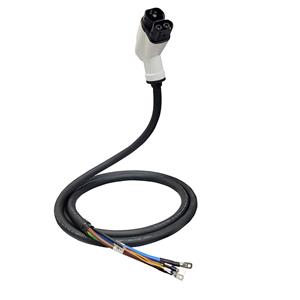
Customization capability can also be valuable. Different EVSE products may require specific cable lengths, terminal arrangements, housing colors, strain-relief structures, temperature sensors, or wiring configurations. A supplier that can adapt the connector assembly to the final charger platform can help OEM manufacturers simplify system integration.
Finally, purchasing decisions should consider lifecycle cost rather than unit price alone. A lower-cost connector may create greater expense if it develops high contact resistance, excessive temperature rise, poor insertion durability, or frequent field failures. Stable manufacturing, engineering support, and long-term supply continuity can provide more value over the complete EVSE product lifecycle.
Conclusion
Type 2 AC charging connector design has a direct impact on both contact temperature and long-term insertion life. Low and stable contact resistance helps reduce heat generation during extended charging, while controlled contact pressure, precise mechanical dimensions, durable materials, and reliable strain relief support repeated daily use. For EVSE manufacturers and procurement teams, the best connector should be evaluated according to thermal performance, contact quality, insertion durability, mechanical strength, production consistency, customization capability, and supplier engineering support. Choosing a reliable Type 2 charging connector supplier can help reduce field failures, improve user experience, and extend the service life of the complete AC charging system.