PCB-Mount vs Busbar-Mount Current Transformers: Which Design Is Better for Your Application?
PCB-Mount vs Busbar-Mount Current Transformers: Which Design Is Better for Your Application?
Current transformers (CTs) are widely used in smart meters, power monitoring equipment, industrial control systems, energy management devices, and electrical distribution applications. While electrical specifications such as current ratio, accuracy, and burden are critical, mechanical mounting design can be equally important when integrating a CT into the final product.
PCB-mount and busbar-mount current transformers are two common solutions used by electrical equipment manufacturers. Both can provide accurate AC current measurement, but they are designed for different installation structures, conductor arrangements, production processes, and current ranges.
For smart meter manufacturers, panel builders, power monitoring OEMs, and procurement teams, understanding these differences can help reduce mechanical redesign, simplify assembly, and select a CT that better matches both electrical and manufacturing requirements.
1. PCB-Mount Current Transformers: Compact Integration for Electronic Equipment
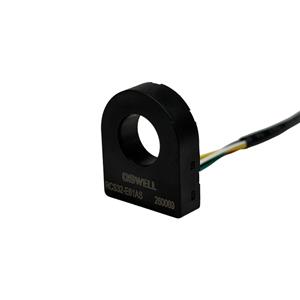
PCB-mount current transformers are designed to be installed directly onto a printed circuit board. Their pins or terminals connect the CT mechanically and electrically to the PCB, making them attractive for compact electronic products where repeatable assembly and space efficiency are important.
Typical applications include:
Smart electricity meters
Power monitoring modules
Energy management devices
Industrial control equipment
Compact electrical instruments
One of the biggest advantages of PCB mounting is production efficiency. During equipment assembly, the current transformer can be installed together with other electronic components, helping reduce additional wiring and separate mounting hardware.
PCB-mounted designs can also improve product consistency because the sensor position is controlled by the board layout. For high-volume OEM production, this repeatable installation can simplify assembly and reduce manufacturing variation.
However, the PCB itself imposes mechanical and electrical limitations. Large primary conductors or very high currents may require busbars that cannot be conveniently routed through a compact board-mounted CT. PCB layout, creepage distance, thermal management, and mechanical stress must therefore be evaluated carefully.
For buyers developing compact metering or monitoring products, PCB-mount CTs are often a strong choice when product size, automated assembly, and integration efficiency are priorities.
2. Busbar-Mount Current Transformers: Better Integration for Higher-Current Systems
Busbar-mount current transformers are designed to work directly with copper or aluminum busbars carrying the primary current. This structure is commonly used in equipment where current levels are higher and the conductor is too large for traditional PCB routing.
Typical applications include:
High-current smart meters
Industrial distribution equipment
Switchgear and electrical panels
Power monitoring systems
Commercial and industrial energy meters
The main advantage of busbar mounting is mechanical compatibility with high-current conductors. The CT can be designed around the busbar dimensions, allowing the primary conductor to pass directly through the magnetic core.
Busbars also provide low-resistance current paths and strong mechanical connections, making them suitable for equipment carrying substantial continuous current.
For OEM manufacturers, busbar-integrated CT designs can simplify high-current assembly because the sensor and conductor structure can be engineered together. In some applications, customized busbars may also reduce the number of separate mechanical parts inside the equipment.
However, buyers should carefully confirm aperture dimensions, busbar thickness, conductor position, mounting tolerances, insulation requirements, and thermal conditions. Small mechanical changes in the final equipment can affect whether a standard CT can be used or whether customization is required.
For high-current applications, supplier engineering support becomes particularly valuable because CT magnetic design and busbar geometry must work together to achieve stable measurement performance.
3. How OEM Buyers Should Choose Between PCB-Mount and Busbar-Mount CTs
There is no single mounting design that is better for every application. The correct choice depends on the electrical architecture, mechanical layout, current level, assembly method, and production volume of the final product.
PCB-mount CTs may be more suitable when:
The equipment has limited internal space
The primary conductor can be routed through the PCB area
High-volume PCB assembly is required
Manufacturing simplicity is a priority
The current range is compatible with compact sensor dimensions
Busbar-mount CTs may be more suitable when:
The application carries higher current
A rigid busbar is already part of the power architecture
Mechanical strength is important
The primary conductor is too large for PCB integration
Customized conductor geometry is required
Procurement teams should also evaluate specifications beyond mounting style, including:
Primary current range
Current ratio
Accuracy class
Rated burden
Frequency range
Insulation performance
Operating temperature
Production consistency
For OEM projects, it is useful to involve the CT supplier early in product development. Providing PCB drawings, busbar dimensions, expected current range, accuracy requirements, and available installation space can help the supplier recommend or customize a suitable design before the equipment layout is finalized.
Supplier production capability should also be considered for volume programs. Stable winding processes, magnetic core consistency, electrical testing, mechanical dimensional control, and traceability help ensure that production CTs match the performance of initial qualification samples.
Conclusion
PCB-mount and busbar-mount current transformers are designed for different integration requirements. PCB-mounted CTs offer compact installation and efficient assembly for electronic monitoring and smart metering products, while busbar-mounted CTs provide stronger mechanical integration for higher-current electrical systems. For OEM manufacturers and procurement teams, the best choice depends on current level, conductor design, installation space, assembly process, accuracy requirements, and production volume. Working with an experienced current transformer supplier early in the design stage can reduce integration risks and help create a more reliable and manufacturable final product.