What 125A Smart Meter Manufacturers Should Evaluate in DC-Immunity Current Transformers
What 125A Smart Meter Manufacturers Should Evaluate in DC-Immunity Current Transformers
High-current smart meters must maintain accurate energy measurement across increasingly complex electrical loads. In 125A applications, power electronic equipment, EV chargers, inverters, switching power supplies, and other non-linear loads can introduce waveform distortion and DC components that may affect conventional magnetic current transformers. DC-immunity current transformers are designed to maintain more stable measurement performance under these conditions. For smart meter manufacturers and procurement teams, selecting the right 125A CT requires more than checking current ratio and physical size. DC immunity, ratio accuracy, phase performance, thermal stability, magnetic margin, mechanical integration, and production consistency all influence the final meter performance.
1. High-Current Metering Requires Stable Accuracy Under DC Bias and Distorted Loads
A conventional current transformer depends on its magnetic core to reproduce the primary current accurately at the secondary side. Under a normal sinusoidal AC load, this process can provide excellent measurement performance. However, a DC component in the primary current can shift the magnetic operating point of the core and reduce the available magnetic margin.
In a 125A smart meter, this becomes especially important because the CT must operate accurately across a wide current range while also handling relatively high full-load current. If the core becomes magnetically biased, ratio error, phase displacement, and waveform reproduction may change.

DC components superimposed on AC current
Harmonic-rich and distorted load waveforms
Low-load and full-load measurement accuracy
Rapid changes in customer load
High-current continuous operation
Long-term operation across different ambient temperatures
For meter manufacturers, the goal is not only to achieve good accuracy under laboratory sine-wave conditions but also to maintain predictable behavior across real customer loads. This is one of the main reasons DC-immunity CTs are important in next-generation smart meter design.
Procurement teams should therefore request performance information under both standard AC conditions and representative DC-bias conditions. A CT that performs well only under ideal test conditions may create additional calibration risk once deployed in more complex electrical networks.
2. Ratio Accuracy, Phase Error, Temperature Stability and Magnetic Margin Must Be Evaluated Together
For high-accuracy smart metering, no single specification can describe the complete performance of a DC-immunity CT. Ratio accuracy determines how closely the secondary signal represents primary current, while phase error influences active power, reactive power, and power-factor calculations.
Temperature stability is equally important. A smart meter may be installed outdoors, inside a distribution cabinet, or in a location with large seasonal temperature changes. Magnetic characteristics and winding resistance can vary with temperature, so the CT should maintain acceptable performance throughout the expected operating environment.
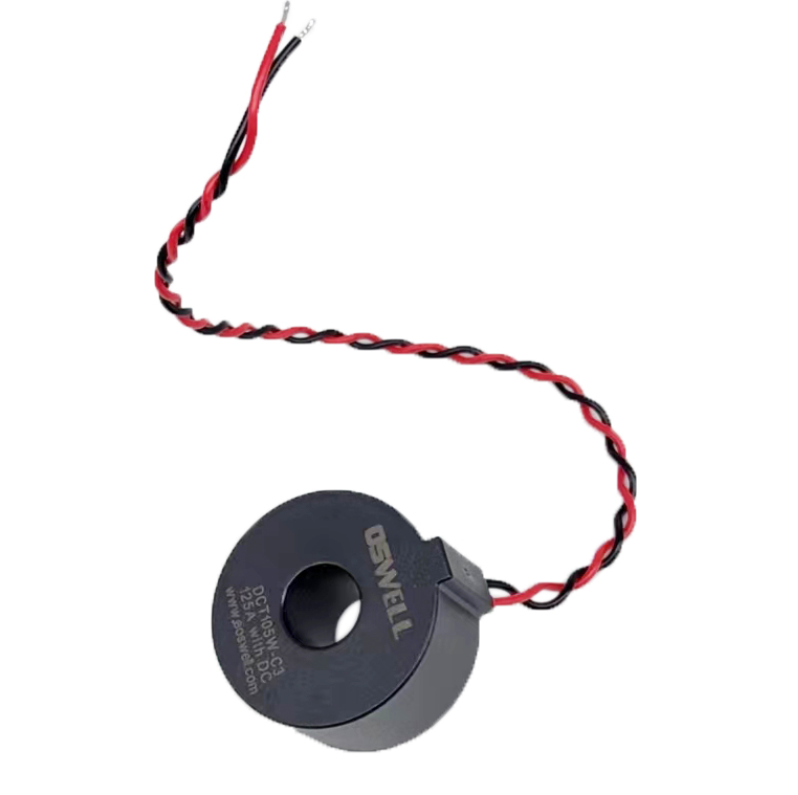
Stable transformation accuracy helps reduce meter calibration variation across low and high current levels.
Controlled phase displacement supports more accurate power and energy calculations.
Stable magnetic and electrical behavior helps maintain accuracy across changing environmental temperatures.
Sufficient core capability helps reduce the influence of DC bias and high-current operating conditions.
OEM designers should also consider the actual burden connected to the CT secondary. Metering IC input characteristics, burden resistance, PCB routing, and secondary wiring all affect the operating condition of the transformer. A CT cannot be evaluated independently from the rest of the measurement circuit.
Mechanical integration matters as well. The conductor opening, busbar position, mounting method, secondary pins, PCB layout, and enclosure size should all be checked before finalizing the component. A technically strong CT may still create production problems if it does not integrate efficiently into the meter architecture.
3. What Procurement Teams Should Check Before Approving a 125A DC-Immunity CT Supplier
High-volume smart meter production places additional requirements on the supplier. One engineering sample with excellent performance is not enough. The real challenge is maintaining the same magnetic, electrical, and mechanical characteristics across thousands or millions of CTs.
125A continuous measurement capability
DC immunity performance
Ratio accuracy
Phase displacement
Temperature stability
Core material consistency
Mechanical and aperture dimensions
Secondary output consistency
End-of-line testing capability
Batch-to-batch repeatability
Procurement teams should ask how the supplier controls magnetic core materials, winding turns, coil positioning, mechanical assembly, and final electrical testing. Small variations in these areas can create measurable differences in ratio error or phase performance.
Sample validation should also include multiple production units rather than a single sample. Engineers can compare accuracy at low, medium, and full current, repeat testing under DC bias, and evaluate performance at different temperatures. This gives buyers a better understanding of the real manufacturing distribution.
Customization capability can also reduce OEM development risk. Different 125A meter platforms may require specific apertures, busbar geometries, mounting positions, secondary outputs, wire configurations, or PCB interfaces. A supplier that can adapt the CT around the meter design can help simplify assembly and reduce mechanical compromises.
Finally, buyers should consider total lifecycle value rather than component price alone. A lower-cost CT may create additional calibration, screening, production rework, or field accuracy problems if its DC-immunity performance is inconsistent. Stable manufacturing, technical support, and long-term supply continuity can provide greater value over the full smart meter program.

Conclusion
For 125A smart meter manufacturers, selecting a DC-immunity current transformer requires careful evaluation of much more than nominal current rating. DC-bias resistance, ratio accuracy, phase displacement, temperature stability, magnetic margin, burden compatibility, mechanical integration, and production repeatability all influence the reliability of the final meter. Procurement teams should validate multiple samples under realistic current, temperature, and distorted-load conditions while also reviewing the supplier's process control and mass-production capability. By selecting a stable DC-immunity CT and an experienced manufacturing partner, smart meter OEMs can reduce calibration variation, improve field accuracy, and build more dependable high-current metering products.