What OEM Designers Should Evaluate When Selecting Closed-Loop Hall Current Transducers for AC/DC Measurement
What OEM Designers Should Evaluate When Selecting Closed-Loop Hall Current Transducers for AC/DC Measurement
Closed-loop Hall current transducers are widely used in battery systems, power converters, industrial drives, renewable energy equipment, charging systems, and other applications that require accurate measurement of both AC and DC current. For OEM designers, however, choosing a suitable transducer involves much more than matching the rated current. Accuracy, offset, linearity, bandwidth, electrical isolation, temperature drift, mechanical integration, and supplier production consistency can all influence the final performance of the equipment.
1. Start With the Complete AC/DC Measurement Requirement, Not Only Rated Current
Closed-loop Hall current transducers use magnetic sensing together with a compensation principle to measure the current flowing through a primary conductor. Because the primary circuit and measurement electronics are electrically separated, this technology is especially useful in high-voltage and high-power equipment where accurate current feedback and electrical isolation are both required.
One major advantage is the ability to measure both AC and DC current. This makes closed-loop Hall technology suitable for applications where current direction changes or where DC current contains switching ripple and other dynamic components.
Battery energy storage systems
Electric vehicle power electronics
Solar and renewable energy inverters
Industrial motor drives
UPS and power conversion equipment
EV charging systems
OEM designers should first define the actual current profile of the application. Maximum current is important, but engineers should also understand nominal current, overload current, bidirectional operation, switching frequency, expected waveform, response time, and operating temperature.
Selecting a transducer only according to the highest current rating can result in poor system optimization. An oversized sensor may increase cost and installation space, while an undersized device may suffer from reduced measurement margin or limited overload capability.
Procurement teams should therefore work with engineering departments to establish a complete requirement before requesting quotations. This makes supplier comparison more meaningful and reduces the risk of changing the transducer after the PCB, busbar, enclosure, and control algorithm have already been designed.
2. Accuracy, Offset, Linearity and Bandwidth Determine Real System Performance
For high-performance AC/DC measurement, headline accuracy is only one part of the specification. The complete error budget may include offset error, gain error, linearity, temperature drift, response time, and phase behavior. These characteristics can influence the accuracy of the final equipment under different operating conditions.
Helps improve measurement around zero current and reduces accumulated error in battery and energy applications.
Supports predictable measurement across low, medium, and high current levels.
Maintains more consistent output when the operating environment changes.
Helps capture dynamic current changes in converters, drives, and switching power systems.
Bandwidth and response characteristics are particularly important in power conversion systems. Current feedback is often part of the control loop, meaning the transducer must respond quickly enough for the controller to detect changing load conditions and regulate switching devices effectively.
In battery applications, offset and thermal drift can be more critical. A small zero-current error may have limited impact during a short measurement, but it can affect long-term charge and discharge calculations if the system continuously integrates the measured current.
Electrical isolation should also be evaluated carefully. Designers need to consider the voltage difference between the primary conductor and low-voltage control electronics, as well as the insulation structure and the mechanical layout surrounding the sensor.
For procurement teams, a useful approach is to request performance data across the intended current and temperature range rather than comparing only a single room-temperature accuracy figure. This provides a more realistic basis for supplier qualification.
3. Mechanical Integration and Supplier Capability Matter in High-Volume OEM Programs
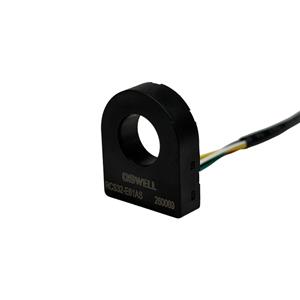
A technically suitable current transducer can still create development problems if it does not fit the mechanical architecture of the equipment. OEM designers should evaluate aperture dimensions, conductor or busbar size, PCB mounting, overall height, connection method, cooling arrangement, and available installation space.
The output interface and power supply requirements must also be compatible with the control electronics. Any mismatch can create additional circuit design, calibration, or component requirements.
Rated AC/DC current range
Measurement accuracy
Zero-current offset
Linearity
Temperature drift
Bandwidth and response time
Electrical isolation
Aperture and mounting dimensions
Output interface compatibility
Batch-to-batch consistency
For high-volume OEM projects, supplier manufacturing capability becomes especially important. Excellent prototype performance has limited value if the same accuracy, offset, and mechanical dimensions cannot be maintained across mass-production batches.
Procurement teams should ask how the supplier controls magnetic components, Hall sensing elements, compensation circuits, mechanical assembly, calibration, and final electrical testing. Production traceability and stable component sourcing can also influence long-term consistency.
Customization capability is another valuable consideration. Different battery packs, inverters, industrial drives, and charging products may require different current ranges, apertures, mounting methods, output configurations, or enclosure structures. A supplier that can adapt the transducer to the application can reduce the amount of redesign required on the OEM side.
Finally, buyers should consider total lifecycle cost rather than only unit price. A lower-cost sensor may create additional calibration, PCB changes, field errors, or redesign work if its performance is unstable. Engineering support, sample validation, production consistency, and long-term supply availability can provide greater value over the complete product lifecycle.
Conclusion
Closed-loop Hall current transducers provide a versatile solution for OEM equipment that requires accurate AC and DC current measurement together with electrical isolation and fast dynamic response. However, successful component selection requires more than checking rated current. OEM designers and procurement teams should evaluate accuracy, zero offset, linearity, temperature drift, bandwidth, isolation, mechanical integration, output compatibility, and production consistency as part of the complete measurement system. By selecting a technically capable supplier with stable manufacturing, customization support, and long-term supply capability, manufacturers can reduce development risk, simplify system integration, and build more reliable battery, inverter, charging, and industrial power products.