Why Onboard AC Contactors Are Becoming a Better Switching Choice for 7kW to 22kW EV Chargers
Why Onboard AC Contactors Are Becoming a Better Switching Choice for 7kW to 22kW EV Chargers
The rapid expansion of residential, commercial, and destination EV charging is creating new design requirements for 7kW, 11kW, and 22kW AC charging equipment. Charger manufacturers are under pressure to reduce enclosure size, control heat generation, improve switching reliability, simplify assembly, and maintain consistent performance across large production volumes. The main switching component inside an AC charger therefore has a direct influence on product reliability and manufacturing efficiency.
Traditional external contactors remain suitable for many electrical applications, but onboard AC contactors are increasingly attractive for compact EV charger designs. By integrating the switching device more closely with the charger's electrical architecture, manufacturers can reduce unnecessary wiring, improve space utilization, and simplify production. For procurement and engineering teams, however, choosing the right onboard AC contactor requires careful evaluation of electrical load, temperature rise, contact resistance, switching life, coil characteristics, mechanical design, and supplier manufacturing consistency.
1. Why 7kW to 22kW EV Chargers Need More Efficient Switching Components
AC EV chargers operate for long periods under relatively high electrical loads. Depending on the charger architecture and local electrical system, products may support single-phase or three-phase charging across the 7kW to 22kW range. During every charging session, the internal switching component must reliably connect and disconnect the power circuit according to commands from the charger controller.
This sounds simple, but the switching component experiences several demanding conditions. High continuous current can generate heat at the contacts and terminals, while frequent switching creates mechanical and electrical stress. At the same time, charger manufacturers are trying to make products smaller, lighter, and easier to manufacture.
Onboard AC contactors can provide advantages by integrating the switching function directly into a more compact charger design. Compared with solutions that require larger separate contactors and additional wiring, onboard designs can help reduce internal space requirements and simplify the electrical layout.
Key advantages may include:
More compact charger architecture
Reduced internal wiring and connection points
Simplified assembly processes
Better use of PCB and enclosure space
Shorter electrical connection paths
More standardized mass-production assembly
For procurement teams, these advantages affect more than component cost. Fewer wiring steps can reduce assembly time, while fewer connection points may lower the risk of installation errors. A more integrated design can also make automated or semi-automated charger production easier to implement.
This is particularly important for OEM manufacturers producing large quantities of wall-mounted EV chargers, destination chargers, and commercial AC charging equipment.
2. Thermal Performance and Contact Reliability Are Critical for Long-Term Charger Operation
One of the most important considerations when selecting an AC contactor for an EV charger is heat generation. Because chargers may operate continuously for several hours, even relatively small electrical losses can contribute to temperature rise inside the enclosure.
Contact resistance is therefore an important parameter. Higher resistance at the switching contacts can produce additional heat under load. Over time, excessive temperature can influence surrounding components, PCB materials, terminals, insulation, and the overall operating life of the charger.
A well-designed onboard AC contactor should provide stable electrical contact performance while maintaining acceptable temperature characteristics under the charger's expected operating current.
Procurement and engineering teams should evaluate:
Rated current and voltage suitability
Contact resistance consistency
Temperature rise under continuous load
Electrical and mechanical switching endurance
Coil power consumption
Terminal and mounting structure
Insulation and dielectric performance
Performance consistency across production batches
Coil characteristics also matter. The contactor must respond reliably to charger control signals while avoiding unnecessary power consumption and heat generation. Stable pickup and release behavior helps ensure predictable switching during normal charging, startup, shutdown, and fault conditions.
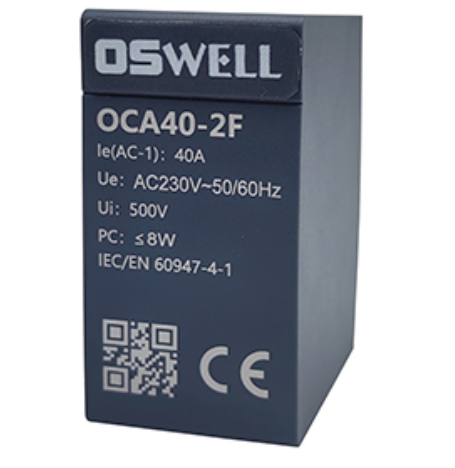
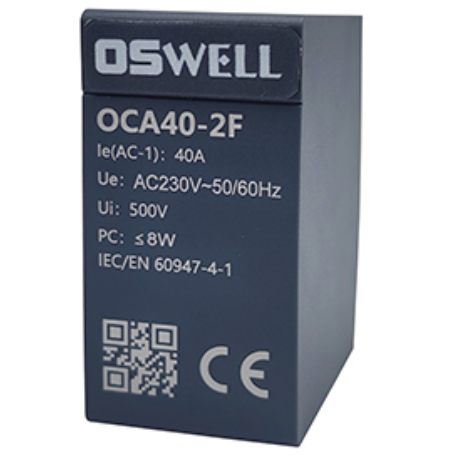
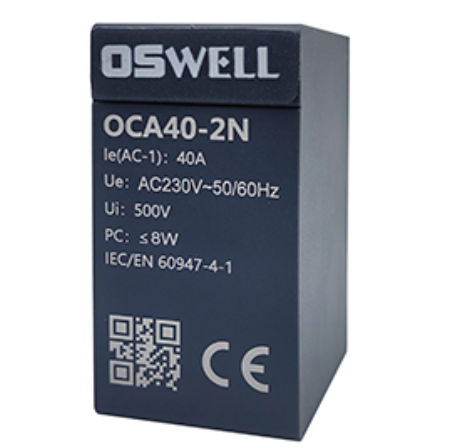
Products such as OSWELL's OCA40 series onboard AC contactors are positioned for integrated EV charging applications where compact installation, switching reliability, and production efficiency are important considerations. Different charger architectures may require different pole configurations or mechanical designs, so component selection should be matched to the complete charging system rather than based only on headline current ratings.
For buyers, requesting thermal test data, endurance information, dimensional drawings, and application guidance during the supplier evaluation stage can help identify potential integration problems before mass production begins.
3. What OEM Buyers Should Evaluate Before Selecting an Onboard AC Contactor Supplier
For an EV charger manufacturer, approving a switching component is a long-term supply-chain decision. Once the contactor has been integrated into the PCB, enclosure, firmware logic, and validation process, replacing it later may require significant redesign and testing.
This means procurement teams should evaluate supplier capability as carefully as the component itself.
Important supplier evaluation factors include:
Experience with EV charging applications
Stable contact material and assembly processes
End-of-line electrical testing
Production traceability
Batch-to-batch performance consistency
Engineering support during charger development
Customization capability
Mass-production capacity
Long-term product availability
Responsive technical communication
Sample testing is especially important. Buyers should validate the contactor under realistic charger operating conditions rather than evaluating it only at room temperature or under short-duration laboratory loads. Continuous current, enclosure temperature, switching frequency, airflow, PCB layout, and terminal design can all affect actual performance.
OEM manufacturers should also consider total lifecycle cost. A lower-cost component may appear attractive during sourcing, but unstable contact resistance, excessive temperature rise, inconsistent switching, or poor production consistency can create much higher costs through warranty claims, rework, field failures, and product redesign.
For 7kW to 22kW charging products, a properly selected onboard AC contactor can therefore provide value beyond basic switching. It can support a more compact product structure, simplified assembly, better production consistency, and a more scalable charger platform.
As AC charging equipment continues moving toward higher integration and larger production volumes, onboard switching solutions are likely to become increasingly important for manufacturers seeking to balance electrical performance, product size, reliability, and manufacturing efficiency.
Conclusion
Onboard AC contactors are becoming an increasingly attractive switching solution for 7kW to 22kW EV chargers because they support compact design, simplified wiring, efficient assembly, and reliable high-current switching. For OEM manufacturers, the most important purchasing factors include contact resistance, thermal performance, switching endurance, coil characteristics, mechanical integration, and production consistency. Selecting an experienced supplier that can provide stable manufacturing, engineering support, and long-term supply can help charger manufacturers reduce development risks and build more reliable products. As EV charging equipment becomes more integrated and competitive, the switching component will remain a critical part of charger safety, performance, and lifecycle value.