EV Charging Project Installation Risk Checklist For Metering Components
How To Reduce Installation Problems In EV Charging Station Projects Before Construction Starts
In EV charging projects, installation problems usually do not begin on the construction day. They begin much earlier, when key project details are not confirmed clearly enough before procurement and site work. A charger may look suitable in the brochure and still create major delays if the site layout, vehicle flow, power route, mounting method, foundation condition, communication setup, and future expansion needs are not aligned before construction starts. This guide explains how buyers, contractors, and project teams can reduce installation problems in EV charging station projects before construction begins.
Why Installation Problems Usually Start Before Equipment Arrives
Many project teams assume installation problems are mainly construction issues. In reality, most of them are planning issues. If the team chooses charger type before confirming parking logic, or finalizes the equipment before checking conduit routes, base locations, and communication conditions, the site often pays later through rework, delay, and avoidable cost.
This is especially common in commercial charging projects, where the charger is part of a larger operating system. It must fit the parking area, the vehicle use pattern, the target user type, the electrical plan, and often the billing or management platform. A charger that is correct in one aspect can still be wrong for the project if those pieces are not aligned early enough.
The best way to reduce installation problems is to treat pre-construction confirmation as part of project design, not as a minor step before delivery.
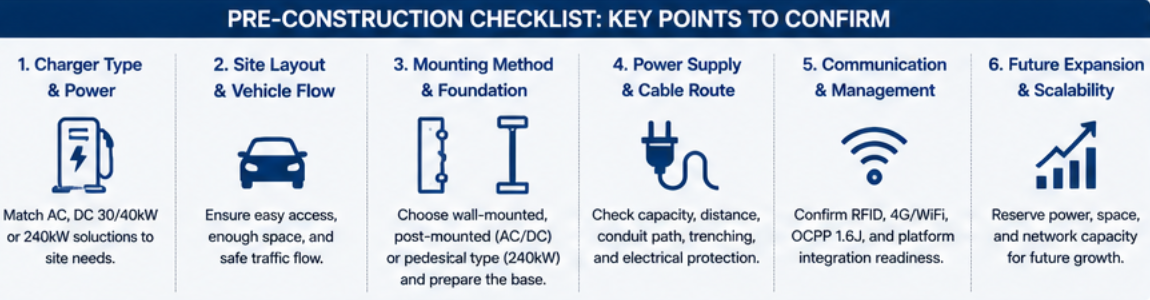
| Pre-Construction Check | Why It Matters | Typical Risk If Skipped |
|---|---|---|
| Charger Type And Power | Defines installation form, electrical demand, and site role | Wrong charger selected for the real site use case |
| Site Layout And Vehicle Flow | Determines charger position and user access | Poor cable reach, awkward parking, difficult access |
| Mounting Method And Foundation | Affects civil work, base preparation, and stability | Base rework, wrong mounting preparation, delayed install |
| Power Route And Cable Planning | Controls trenching, conduit, and connection path | Cable re-routing, longer construction time, added cost |
| Communication And Management Setup | Supports commissioning and future operation | Late integration problems with RFID, 4G, or OCPP |
| Future Expansion | Helps avoid expensive redesign later | No room for added chargers or future site scaling |
Confirm The Site Layout Before Finalizing The Hardware
One of the most common early mistakes is choosing the charger first and asking how it will fit later. The stronger approach is the opposite. The team should first understand how vehicles enter the site, where they park, how long they stay, and whether the charger should be wall-mounted or pedestal-mounted.
Your brochure already shows why this matters. The 7–22kW AC charging station and the 30/40kW DC charging station both support wall-mounted or post-mounted installation. That means installation type is part of the product choice, not just a construction decision. If the parking logic requires open-lot placement, pedestal mounting may be more practical. If the site already has strong wall-side parking conditions, wall mounting may be simpler.
When the layout is confirmed early, the charger can be selected to fit the site instead of forcing the site to adapt later.

Confirm Power, Cable Route, And Site Readiness Together
Another common installation problem happens when charger selection and electrical planning are done separately. The team may know the charger output, but still fail to confirm how power reaches the charger, where conduit should be placed, how trenching affects the parking area, or whether the site should reserve room for future expansion.
This becomes even more important with commercial DC charging. The 30/40kW DC charging station and the higher-power 240kW series require more deliberate planning around power and placement. The brochure also shows that these products are built for connected and managed charging with features like RFID, WiFi, 4G, app control, and OCPP-related communication. These features mean the charger is part of a larger operating system, not just a standalone electrical point.
If power planning, cable route planning, and communication planning are reviewed together before construction, many site problems become much easier to avoid.
Plan For Operation, Not Only Installation
Construction should not be planned as if the project ends when the charger is physically installed. The charger still needs to work well afterward. That means the project should confirm user access, remote communication, RFID logic, 4G or network conditions, app control needs, and platform integration before construction starts rather than after commissioning begins.
This is especially important in commercial charging, where the station may serve staff, tenants, shoppers, public drivers, or fleets. If these operating needs are ignored during early project planning, the charger may be installed correctly but still perform poorly from an operational point of view.
A good charging project is not only built correctly. It is prepared correctly from the beginning.
Build A Pre-Construction Checklist, Not Just A Delivery Schedule
The easiest way to reduce installation problems is to create a real pre-construction checklist. This should cover charger type, power level, installation form, site layout, base location, conduit path, communication requirements, connector compatibility, and future expansion allowance. Once these are confirmed, the construction process becomes much easier to control.
Many problems that appear to be “installation issues” are really incomplete planning issues. Solving them before construction always costs less than solving them after equipment delivery or civil work has already started.
The strongest charging projects are not the ones that build fastest. They are the ones that prepare well enough to avoid preventable mistakes.
FAQ
Why do installation problems often appear before construction starts?
Because the real issues usually begin with incomplete planning around site layout, power routing, charger position, and communication setup.
Should charger type be decided before the site layout?
Not ideally. The better process is to understand the site layout and user flow first, then match the charger type and mounting form to that environment.
Why should RFID, 4G, or OCPP be considered before construction?
Because commercial chargers are often part of a broader operating system. Communication and access features should be planned before installation, not added later as an afterthought.
What is the most practical way to reduce construction problems?
Build a pre-construction checklist that confirms charger type, layout, cable route, mounting, communication, and expansion before delivery and civil work begin.
Contact Us
Looking for the right EV charging solution for your project? Contact our team to discuss charger type, site layout, cable planning, smart functions, and the best construction-ready solution for your site.
EV Charging Project Installation Risk Checklist For Metering Components Component Selection Notes
This article is aligned with the actual EOSWELL product range. For metering, EV charging, utility monitoring and industrial power projects, buyers usually need reliable current transformers, miniature voltage transformers, latching relays, shunt resistors, sensors and stamping parts rather than only a general system description. The important question is how these components support accurate measurement, safe switching and stable project operation.
The first product route should be reviewed through current transformers, latching relays, shunt resistors, battery shunt resistors, power system sensors, metering component product range. These pages connect the article to real product categories and help a visitor move from a search question to a practical inquiry path on the same site.
Procurement Details Buyers Should Confirm
- Confirm current range, voltage range, accuracy class, insulation level, temperature rise, mounting method and wiring layout.
- For charging or metering projects, define whether the design needs CT metering, DC immunity, latching relay switching, shunt measurement or power system sensing.
- Ask for drawings, sample approval, test reports, reliability data, production photos and packaging details before bulk order.
- Clarify whether the component will be used in single phase meters, three phase meters, charging equipment, protection systems or industrial monitoring devices.
- Review certification, test conditions, lead time, repeat order stability and engineering communication before choosing a supplier.
Internal Product Route For Better Evaluation
Additional review should continue with miniature voltage transformers, split core CT, connect and stamping parts, test laboratory, transformer production, CT production. Factory and test pages matter because metering components need repeatable production, controlled winding, stable contact performance, reliable shunt resistance and documented testing. Buyers comparing suppliers should not rely on a short article only.
For project confidence, relay production, application cases, company capability provide cases, company background and inquiry support. These internal links keep authority within the same website and give Google a clearer relationship between component articles and product pages.
Quality Review Before Order Confirmation
Before order confirmation, the buyer should check drawings, tolerance, material, rated current, rated voltage, relay coil voltage, contact resistance, burden, accuracy class, insulation test, temperature rise, life cycle requirements and packaging method. For EV charging and energy metering projects, component reliability directly affects safety, billing accuracy and maintenance cost.
| Check Item | Buyer Value |
|---|---|
| Accuracy and rating | Supports reliable metering, sensing and protection performance. |
| Production and test record | Improves repeat order stability and supplier accountability. |
| Application fit | Prevents using a general component in a demanding project condition. |
Search And Inquiry Value
The page now answers product specific questions and links them to real current transformer, voltage transformer, relay, shunt and test capability pages. This makes the article more useful for search visitors and helps turn technical traffic into qualified inquiries.