How To Choose A 7kW, 22kW, 40kW Or 240kW Pedestal EV Charger For Your Site
How To Choose A 7kW, 22kW, 40kW Or 240kW Pedestal EV Charger For Your Site
Choosing the right pedestal EV charger is not only about selecting a higher or lower power level. The real decision depends on parking time, vehicle turnover speed, site traffic, electrical capacity, business model, and the type of users the project needs to serve. A 7kW or 22kW pedestal charger may be the right choice for long-stay parking, while a 40kW or 240kW charger may be far more suitable for commercial sites that require faster charging turnover. This guide explains how to choose between 7kW, 22kW, 40kW, and 240kW pedestal EV chargers so buyers can match the charger to the actual site instead of choosing only by output number.
1. Why Charger Power Should Match Site Use, Not Just Buyer Preference
In many EV charging projects, buyers start by asking for the biggest power they can afford. But the best charger is not always the most powerful one. A charger that is too small for the real site may cause poor user experience and low turnover efficiency, while a charger that is too large may increase project cost without adding enough practical value. The correct power level depends on how long vehicles stay, how often spaces turn over, and whether the site is designed for destination charging or faster public service charging.
This matters even more in pedestal charging projects because pedestal chargers are often installed in open commercial parking areas, business parks, retail lots, public institutions, and fleet environments. In these places, the charger becomes part of the parking strategy, not just an electrical device. The power level should therefore match the real behavior of drivers on site.
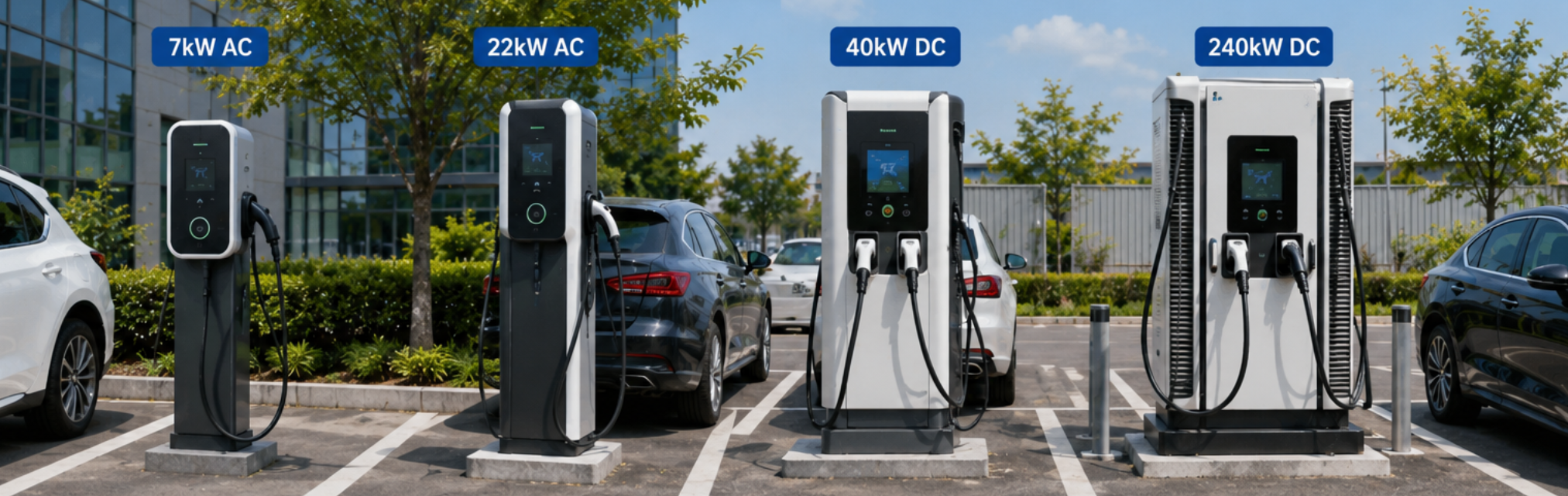
Your brochure already shows this range clearly: lower-power AC pedestal solutions are suitable for everyday parking-oriented charging, while higher-power DC pedestal solutions are designed for faster charging demand and broader commercial use. It also shows that these products support different commercial features such as RFID, OCPP, WiFi, 4G, app control, and multiple market connector options.
The right charger power is the one that fits the real parking and usage pattern of the site.
| Power Level | Typical Charging Role | Best Fit Site Type |
|---|---|---|
| 7kW Pedestal AC Charger | Basic destination charging for longer parking stays | Residential-commercial sites, office parking, low-turnover bays |
| 22kW Pedestal AC Charger | Faster AC charging for commercial destinations | Commercial real estate, public parking, business parks |
| 40kW Pedestal DC Charger | Medium-speed DC charging with stronger turnover capability | Retail, mixed-use commercial sites, public charging projects |
| 240kW Pedestal DC Charger | High-power charging for high-demand and fast-service locations | Fleets, public fast-charging hubs, transportation projects |
2. When 7kW Or 22kW Pedestal Chargers Are The Better Choice
A 7kW pedestal charger is usually the better choice when vehicles stay parked for longer periods and the site does not depend on fast turnover. This is common in smaller office projects, residential-commercial parking, employee parking, and some lower-intensity destination charging environments. In these cases, charging speed matters less than stable daily convenience.
A 22kW pedestal charger is often better when the site still serves destination charging, but the buyer wants stronger commercial flexibility and a faster AC charging experience. It can be more attractive for office parks, retail centers, public institutions, and commercial real estate where EV users stay for meaningful periods but still expect faster charging than basic residential-style charging.
According to the brochure, the 7–22kW AC charging station supports post-mounted installation, multiple market connector options, and commercial features including RFID, Plug & Play, BLE, WiFi, 4G, OCPP 1.6J, IP54 protection, and customization support. That makes this range suitable for projects where smart management matters as much as hardware installation.
In general, 7kW and 22kW pedestal chargers are best when charging time is available and the project is more parking-oriented than turnover-oriented.
3. When 40kW Or 240kW Pedestal Chargers Are The Better Choice
A 40kW pedestal DC charger is usually the better choice when the site needs faster charging but does not yet require ultra-high-power service. It is well suited to mixed-use commercial developments, public parking areas, roadside business sites, and medium-turnover commercial projects where buyers want stronger charging performance and a more commercial-grade user experience.
A 240kW pedestal DC charger is the better choice when fast charging performance is central to the business model. This includes fleets, public fast-charging stations, transportation projects, and high-demand commercial locations where shorter charging time and higher user throughput matter much more than simple installation economy.
The brochure shows that the 30/40kW DC charging station supports commercial functions such as RFID, Plug & Play, payment, WiFi, 4G, app control, and customization. It also shows that the 240kW DC charging station is designed as a pedestal type and is aimed at applications including fleets, commercial real estates, public organizations, and intelligent transportation.
In practical terms, 40kW is often the step-up choice for stronger commercial charging, while 240kW is the clear choice for projects where charging speed and throughput are core business requirements.
4. How To Choose The Right Power Level For Your Site
Buyers should first ask how long vehicles usually stay. If drivers park for several hours, a 7kW or 22kW pedestal charger may already be the right solution. If drivers expect faster service and the site is part of a higher-turnover commercial operation, 40kW may be the better balance. If fast charging is the real value proposition and vehicle turnover is critical, 240kW becomes much more suitable.
The second question is what kind of users the site will serve. Office staff, shoppers, and long-stay commercial visitors usually fit lower or mid-power charging better. Public fast-charging users, fleet operations, and transportation-related projects usually need stronger DC charging performance.
The third question is whether the project is being built for today only or for expansion later. A smaller first-phase site may begin with 7kW or 22kW pedestal chargers and later expand into 40kW or higher-power DC charging as demand grows. In other projects, starting directly with 40kW or 240kW may be the right choice if the business model already depends on stronger charging service from day one.
The best pedestal charger is not simply the one with the highest power. It is the one whose power level matches the real usage pattern, user expectation, and business plan of the site.
Conclusion
To choose the right 7kW, 22kW, 40kW, or 240kW pedestal EV charger, buyers should focus on real site use, not just the power number. Lower-power pedestal chargers are usually better for longer parking duration and destination charging. Higher-power pedestal chargers are usually better for faster turnover, stronger commercial performance, and high-demand public or fleet charging. The right solution is the one that matches how your site will actually be used.
Contact Us
Looking for the right pedestal EV charger for your site? Contact our team to discuss charging power, connector type, site layout, and project requirements.