Post-Mounted EV Charging Station vs Wall-Mounted Charger: Which Is Better For Commercial Sites?
Post-Mounted EV Charging Station vs Wall-Mounted Charger: Which Is Better For Commercial Sites?
For commercial EV charging projects, the choice between a post-mounted charging station and a wall-mounted charger affects much more than appearance. It directly influences parking layout, user convenience, cable reach, civil work, visibility, site flexibility, and future expansion. Many buyers compare output power, connector type, and smart functions first, but mounting form can determine whether the project is truly practical after installation. This guide explains the real differences between post-mounted and wall-mounted EV chargers and helps commercial buyers choose the better option for their site.
1. Why Mounting Type Matters More In Commercial Projects
In residential charging, the mounting choice is often simple because the charger usually serves one vehicle in one predictable space. Commercial projects are different. The charger may need to serve multiple parking users, fit different vehicle positions, work in open outdoor areas, align with branding requirements, and leave room for future expansion. Because of this, mounting type becomes a project decision, not just a hardware preference.
A wall-mounted charger is attached directly to a structural wall or support surface. It is often attractive when the site already has a suitable wall near the parking spaces and when the buyer wants a clean, simple installation with less occupied ground space. A post-mounted charging station stands independently, which gives the project much more freedom in where the charger is placed and how vehicles approach it.
In commercial sites, this difference matters because the charger is not only an electrical product. It is part of the parking experience, the site workflow, and sometimes even the visual identity of the property. If the mounting type is chosen too early or only by appearance, the project may later face inconvenient cable reach, awkward parking behavior, difficult expansion, or avoidable installation changes.
The better choice is the one that fits the real parking layout, not simply the one that looks more common.
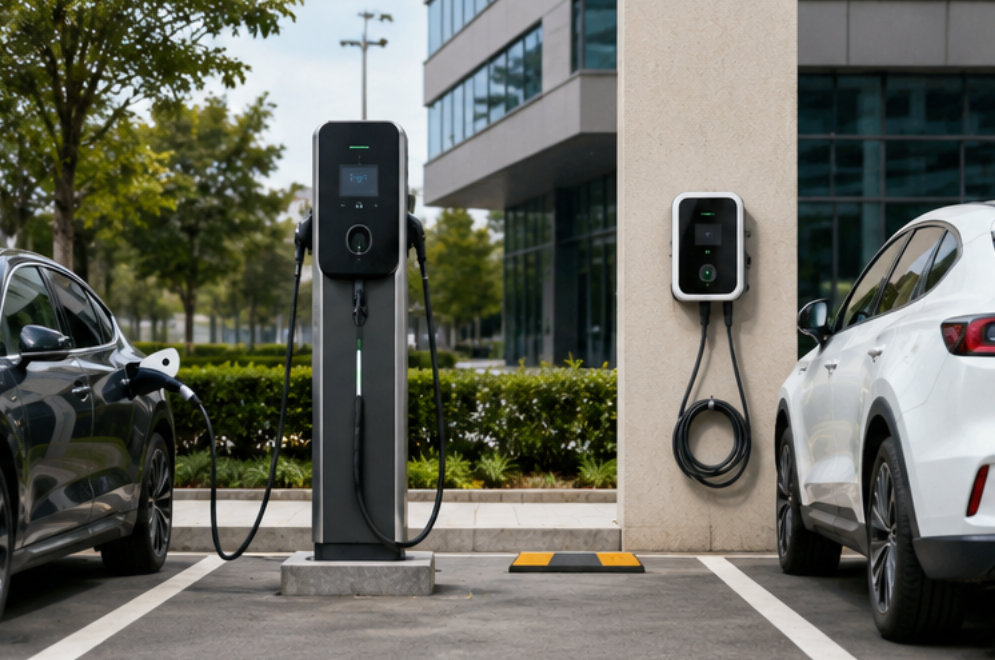
| Comparison Point | Post-Mounted Charging Station | Wall-Mounted Charger |
|---|---|---|
| Placement Flexibility | Can be positioned where the parking flow needs it most | Depends on existing wall availability |
| Commercial Visibility | Usually stronger for branding and wayfinding | Lower visual presence in many open parking areas |
| Parking Lot Compatibility | Better for islands, open bays, and central charging positions | Better for wall-side parking spaces |
| Expansion Convenience | Usually easier to replicate across open commercial sites | Works well when expansion stays along a building edge |
| Ground Space Impact | Needs a dedicated footprint | Saves ground space when a strong wall is available |
| Best Fit | Retail, public parking, commercial plazas, open lots | Garages, perimeter parking, wall-adjacent commercial bays |
2. When A Post-Mounted Charging Station Is Usually The Better Choice
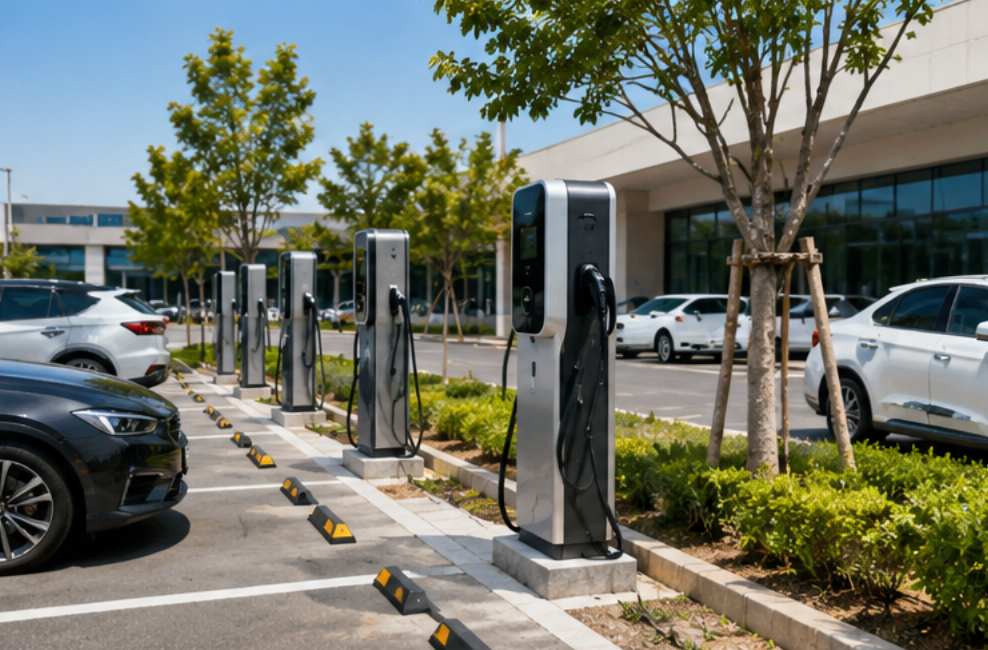
A post-mounted charging station is usually better when the parking layout should drive the installation position instead of the building wall. In open commercial parking areas, shopping centers, public institutions, office parks, and roadside charging points, vehicles often park in ways that are easier to serve from a freestanding charger placed near the center or edge of the bay group. This makes cable reach and user access more practical.
Post-mounted units are also better when visibility matters. In commercial projects, the charger is often part of the customer-facing experience. A freestanding charger is easier to notice, easier to brand, and easier to integrate into a site plan where the operator wants charging to be clearly visible to drivers. This is especially useful in public or semi-public charging environments.
Another advantage appears when the site may expand later. If the first phase begins with a few bays and future phases may add more chargers, post-mounted layouts usually make planning easier because the charger position is not limited to wall lines. This gives the property owner more freedom to scale with parking demand and power planning.
For most open commercial sites, post-mounted chargers are often the more natural long-term choice because they are designed around how vehicles use the site, not around where the building wall happens to be.
3. When A Wall-Mounted Charger Is Usually The Better Choice
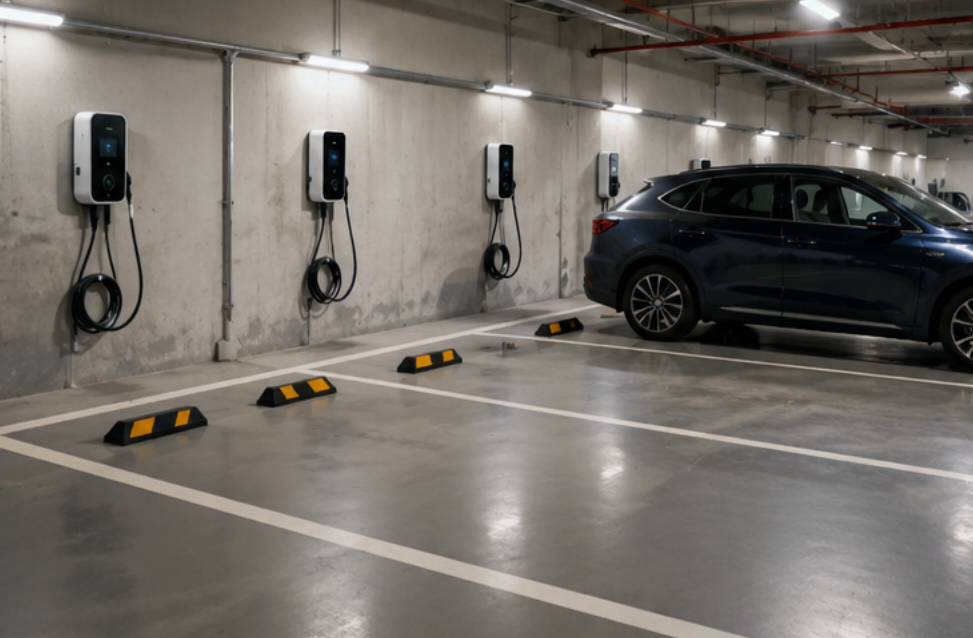
A wall-mounted charger is usually better when the site already has strong, well-positioned walls next to the charging bays. This is common in underground parking garages, building-side parking areas, logistics yards with perimeter parking, and certain commercial properties where the charging spaces are already arranged along a wall. In these cases, wall mounting can create a clean and efficient layout with less ground obstruction.
Wall-mounted designs can also be attractive when buyers want a more compact installation style. Because the charger is attached to the wall, it does not require a separate pedestal footprint. This can be useful in tighter parking environments where ground space is limited or where vehicle movement needs to remain very open.
Another benefit is that wall-mounted chargers may fit well in smaller first-phase commercial rollouts. If the operator is starting with a limited number of bays and already has a suitable electrical room or installation surface nearby, a wall-mounted solution can be practical and visually simple. It works best when the site structure already supports it naturally.
Wall-mounted chargers are usually the better choice when the building already provides the right installation condition and the parking flow does not require independent charger positioning.
4. Which One Is Better For Commercial Sites Overall
For most open commercial sites, a post-mounted charging station is usually the better choice because it offers better placement flexibility, stronger charger visibility, and a layout that follows the parking area rather than the building wall. This is especially true for public parking, retail projects, commercial real estate, and outdoor installations where user convenience and future expansion matter.
A wall-mounted charger becomes the better option when the site already has a suitable wall-based layout and the buyer wants a cleaner, more compact installation with less ground footprint. In wall-adjacent bays, parking garages, and smaller rollout phases, wall-mounted chargers can be very practical and cost-efficient.
The most important point is that buyers should choose based on site layout first, not product form first. A charger that fits the real parking logic will always perform better than one selected only because it appears simpler in catalog comparison.
The better commercial solution is the one that makes charging easier for drivers, easier to install for the project team, and easier to scale for the property owner.
Conclusion
Post-mounted EV charging stations are usually better for open commercial sites where charger visibility, parking flexibility, and future expansion are important. Wall-mounted chargers are usually better when the building already provides the right installation position and a more compact wall-side layout. For commercial buyers, the smartest decision is to choose the mounting form that fits the real parking and operating logic of the site rather than choosing only by appearance or habit.
Contact Us
Looking for the right EV charging solution for your commercial site? Contact our team to discuss charging power, installation layout, mounting form, and project requirements.