Split Core vs Solid Core Current Transformer: Key Differences For Metering Applications
Split Core vs Solid Core Current Transformer: Key Differences For Metering Applications
In metering applications, choosing between a split core current transformer and a solid core current transformer is not simply a structural decision. It affects installation method, retrofit flexibility, measurement stability, mechanical integrity, long-term consistency, and overall project efficiency. This guide explains the key differences between split core and solid core CTs, and how to choose the right option for smart meters, energy monitoring systems, and other metering-related applications.
1. Structural Difference And Installation Impact
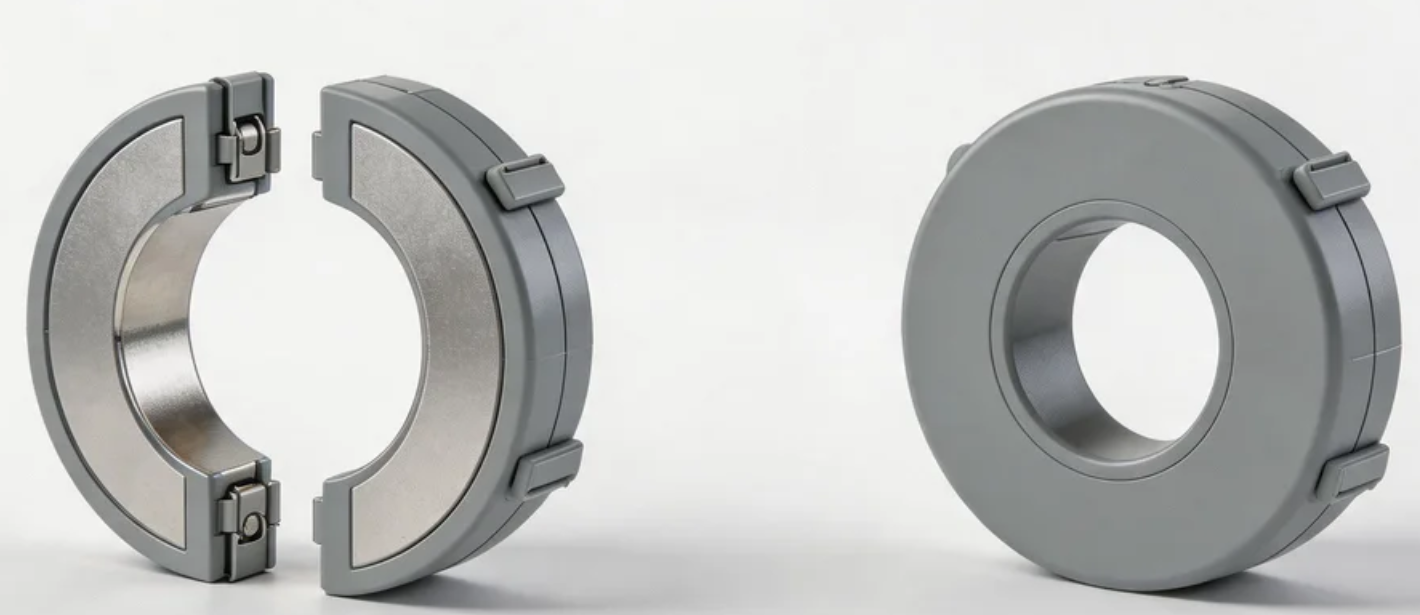
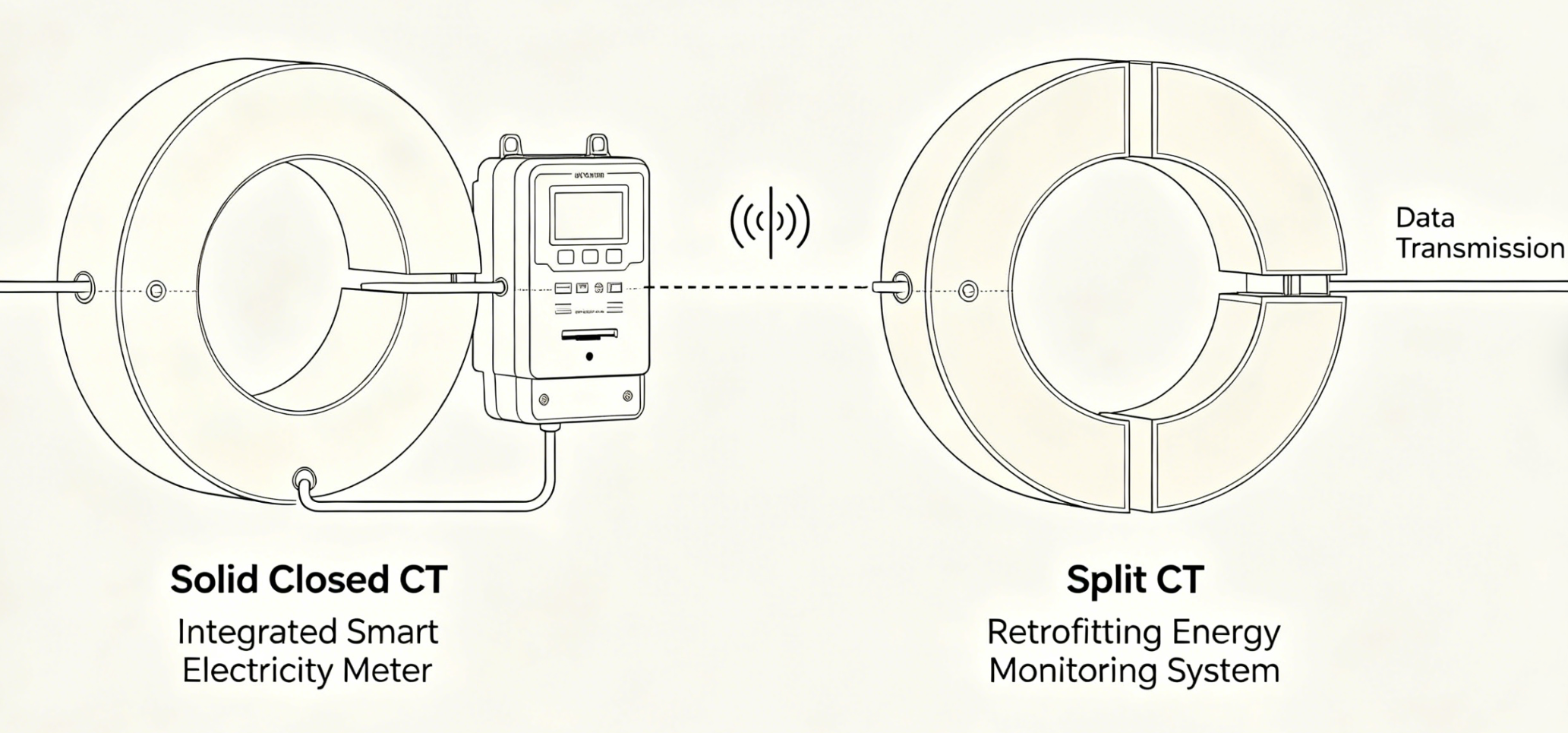
The most visible difference between split core and solid core current transformers is the physical structure of the magnetic core. A solid core CT uses a fully closed ring structure. The primary conductor must pass through the center opening during installation, which means the electrical line usually needs to be disconnected or integrated during assembly. This design is simple, mechanically continuous, and widely used in embedded meter structures or controlled production environments where the conductor path is planned in advance.
A split core CT, by contrast, is designed with an opening core structure that can be separated and then closed around an existing conductor. This makes installation much easier in retrofit projects, energy audits, power monitoring upgrades, and applications where the line cannot be disconnected. For many field projects, this is the biggest advantage. Installers can mount the CT around a cable or busbar without shutting down the system, which improves site efficiency and reduces disruption.
However, the convenience of the split core structure also introduces additional design requirements. Because the core must open and close reliably, the hinge, locking mechanism, mating surfaces, and mechanical tolerance become critical. If the two sides of the core do not align well, magnetic performance may be affected. In metering applications, even small variations in the magnetic path can influence accuracy stability and repeatability.
Solid core CTs avoid this issue because the core is continuous and permanently closed. This usually supports stronger magnetic integrity and a more stable physical structure. As a result, solid core designs are often preferred when installation conditions are controlled and the highest emphasis is placed on mechanical simplicity, compact integration, and long-term repeatability in fixed meter assemblies.
2. Performance Differences In Metering Applications
When engineers compare split core and solid core current transformers for metering applications, performance should be evaluated from a system perspective rather than from structure alone. The right choice depends on whether the project prioritizes installation flexibility, accuracy consistency, compact design, or field deployment speed.
In general, solid core CTs are often favored in meter designs that require stable structure, controlled assembly, and consistent magnetic conditions. Because the core does not open, there is no interface gap caused by repeated opening and closing. This can support predictable electrical behavior and help maintain stable performance across production batches when the design and manufacturing process are well controlled.
Split core CTs, on the other hand, provide a major advantage in installation practicality. In retrofit metering, building energy monitoring, panel upgrades, and temporary measurement scenarios, a split core design can significantly reduce labor complexity. For many users, this operational advantage outweighs the added structural complexity, especially when the CT has been engineered with precise mating surfaces, reliable closure force, and stable winding quality.
Another important factor is space and mounting. Solid core CTs are often easier to integrate into planned product layouts where the conductor path, PCB arrangement, and enclosure design are fixed from the beginning. Split core CTs are usually more suitable when the installation environment is less predictable or when the conductor is already in place. In such cases, the ability to install without changing the wiring route becomes a major project benefit.
Reliability must also be assessed differently. For solid core CTs, the focus is often on electrical consistency, insulation stability, and dimensional fit. For split core CTs, mechanical closure quality, repeatable alignment, and secure locking become equally important. In metering projects, both structures can perform well when properly designed and matched to the application, but the decision criteria are not identical.

| Comparison Item | Split Core CT | Solid Core CT |
|---|---|---|
| Installation Method | Can be installed around an existing conductor | Requires conductor to pass through closed core |
| Best Use Scenario | Retrofit, non-shutdown, field upgrade projects | Integrated meter assembly and fixed production layouts |
| Mechanical Structure | Opening and closing structure with hinge or latch | Continuous closed structure |
| Alignment Requirement | High importance for mating surface precision | Lower risk of interface-related misalignment |
| Metering Stability Focus | Depends on closure consistency and structural precision | Depends on core design, winding control, and material consistency |
| Project Advantage | Fast installation and strong retrofit value | Compact, stable, and easy to integrate in planned designs |
3. How To Choose The Right CT For Your Metering Project
The best way to choose between split core and solid core CTs is to begin with the actual project condition. If the application involves new smart meter development, planned internal assembly, stable conductor routing, and controlled manufacturing, a solid core current transformer is often the more natural choice. Its closed structure fits well into a repeatable production environment and supports strong physical continuity for long-term use.
If the application involves upgrading an existing electrical system, monitoring live circuits, or adding measurement points without major rewiring, a split core CT is usually more practical. This is especially valuable in retrofit energy monitoring, building metering improvement, facility management, and projects where power interruption is expensive or unacceptable. In these situations, installation efficiency becomes a major part of system value.
Project teams should also consider how the CT will be validated. For solid core designs, attention should be given to current ratio suitability, thermal behavior, insulation performance, and dimensional compatibility with the meter housing and conductor path. For split core designs, those factors remain important, but additional attention should be paid to repeated open-close consistency, latch strength, alignment precision, and long-term mechanical reliability.
Another useful decision point is who will install the product. If installation will be performed in a factory with standardized procedures, a solid core CT can often be integrated effectively. If installation will occur on-site by technicians working in space-constrained panels or operating systems, the flexibility of a split core CT may bring a more practical advantage.
Ultimately, neither structure is universally better. The better CT is the one that best matches the metering system, installation method, reliability target, and operational constraints of the project. When these factors are evaluated together, the comparison between split core and solid core becomes much clearer, and the final choice is more likely to support both technical performance and project efficiency.
Conclusion
Split core and solid core current transformers each offer clear advantages for metering applications, but they solve different project needs. Split core CTs stand out for retrofit flexibility, non-shutdown installation, and field convenience. Solid core CTs stand out for structural continuity, planned integration, and stable use in fixed meter assemblies. The right decision should be based on installation conditions, system design, mechanical requirements, and long-term reliability goals. By selecting the CT structure according to the real application instead of structure alone, metering projects can achieve better efficiency, stronger performance stability, and lower implementation risk.
Contact Us
Looking for the right current transformer solution for your metering application? Contact our team to discuss split core and solid core CT options for your project.