Wall Mounted And Pedestal EV Charger Component Selection Guide
Wall-Mounted Or Pedestal EV Charging Station: Which Installation Type Fits Your Site Better?
In EV charging projects, installation type affects much more than product appearance. It influences parking layout, cable reach, charger visibility, construction complexity, driver convenience, and future expansion potential. Many buyers compare connector type, power output, and software functions first, but mounting form often determines whether the project works smoothly after installation. This guide explains the real difference between wall-mounted and pedestal EV charging stations and helps buyers choose the installation type that fits their site better.
Why Installation Type Matters Early In The Project
In many projects, buyers decide the charger model first and think about the installation type later. That often leads to avoidable problems. A charger may be technically suitable and still create inconvenience if the mounting form does not match the site layout. Drivers may find the charger awkward to access, cables may not reach naturally, civil work may become more complicated, or future expansion may become harder than expected.
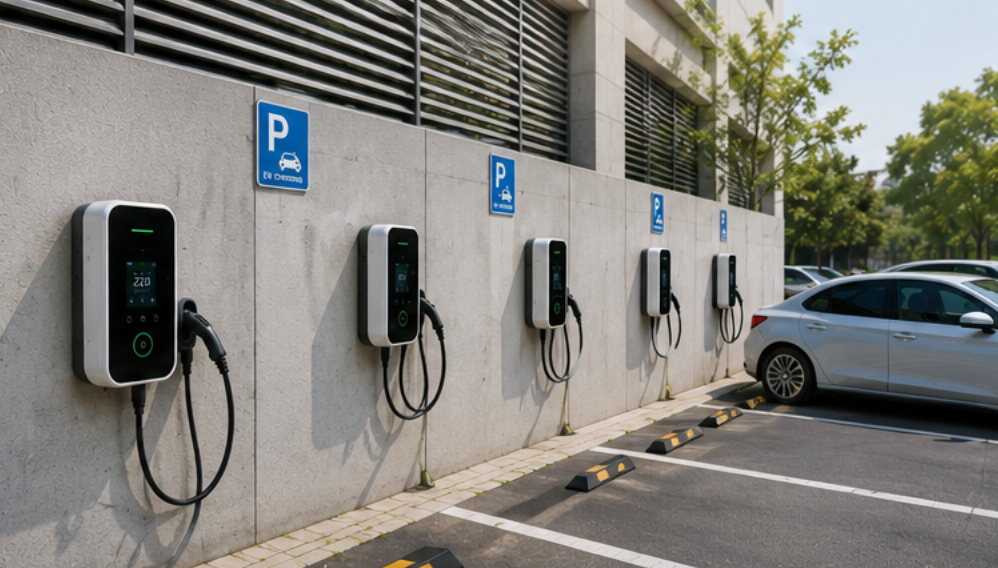
This is especially important in commercial, public, and outdoor charging environments. A wall-mounted charger depends on a suitable building wall or structural surface. A pedestal charger stands independently and can be placed according to how the parking area actually works. That difference becomes much more important when the project serves multiple users, open parking spaces, public traffic, or staged expansion.
The better installation type is not the one that looks simpler in a catalog. It is the one that fits the real parking logic, charger visibility, and future operating needs of the site.
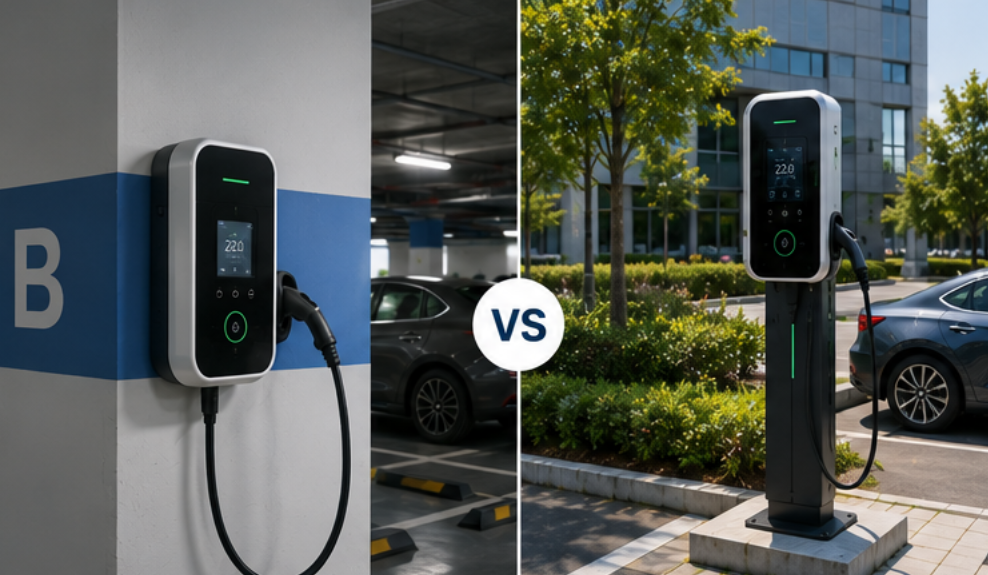
| Comparison Point | Wall-Mounted Charger | Pedestal Charging Station |
|---|---|---|
| Placement Logic | Depends on existing wall position | Follows parking layout and vehicle access |
| Ground Space Use | Saves floor footprint when a wall is available | Needs a dedicated footprint and base |
| Parking Lot Flexibility | More limited in open parking areas | Better for islands, central bays, and open lots |
| Visibility | Can be less visible in public sites | Usually stronger for wayfinding and branding |
| Best Fit | Wall-side parking, garages, perimeter spaces | Public parking, commercial lots, open outdoor charging projects |
When Wall-Mounted Chargers Are Usually The Better Choice
Wall-mounted chargers are usually the better choice when the site already has a suitable structural surface in the right location. This often happens in underground garages, building-side parking areas, perimeter parking spaces, and certain compact commercial sites. In these environments, wall installation can create a clean and efficient arrangement with less occupied ground space.
Wall-mounted chargers also work well when the project is more controlled and predictable. If the vehicles park in a fixed pattern along a wall and the electrical route already follows the building edge, wall mounting may simplify the installation strategy. It can be especially practical in earlier-stage rollouts where the site starts with a small number of charging spaces and does not yet need a highly visible public charging zone.
In short, wall-mounted installation is usually better when the building already provides the right support structure and the parking pattern naturally follows that wall.
When Pedestal Charging Stations Are Usually The Better Choice
Pedestal charging stations are usually the better choice when the site layout should decide charger placement rather than the building wall. This is common in open commercial parking lots, public charging areas, office parks, retail parking projects, and transportation-related sites. In these environments, the charger often needs to be positioned between bays, on parking islands, or in central parking areas where wall-mounted solutions would be too limiting.
Pedestal chargers are also often better when visibility matters. In public-facing or commercial sites, the charger is not only a utility device. It is part of the site experience and often part of the property’s EV-ready image. A freestanding charger is easier to see, easier to integrate into parking-lot design, and often easier to expand later as EV demand grows.
Your brochure supports this clearly, because both the 7–22kW AC charging station and the 30/40kW DC charging station are shown as supporting wall-mounted or post-mounted installation. That means these products are already positioned for project-based selection rather than one fixed installation method only.
In most open, public, or growth-oriented parking environments, pedestal charging stations are usually the more flexible long-term choice.
How To Decide Which One Fits Your Site Better
The first question buyers should ask is whether the parking layout is organized around the building edge or around the parking area itself. If the site naturally places vehicles beside a strong wall with easy electrical routing, wall-mounted may be the better fit. If the site needs chargers in open spaces, islands, public lots, or more central positions, pedestal charging usually becomes more practical.
The second question is whether the charger should be visible as part of the project identity. Public and commercial projects often benefit from more visible pedestal chargers because they are easier for drivers to locate and easier to integrate into a larger EV-ready parking strategy.
The third question is whether the site may expand later. Pedestal installations usually give more freedom for phased growth across a parking lot, especially in larger public or commercial projects. Wall-mounted installations can be very effective too, but usually work best when future expansion stays aligned with the same building-side logic.
The better installation type is the one that matches the real movement, parking, visibility, and future growth pattern of the site.
FAQ
Are pedestal chargers better for outdoor projects?
In many open parking and public charging areas, yes. Pedestal chargers are often easier to position where vehicles actually need them.
When is wall-mounted better?
Wall-mounted is usually better when the parking spaces already run along a suitable wall and the site does not need charger placement in open areas.
Can the same charger model support both installation types?
In some product ranges, yes. Your brochure shows that both the 7–22kW AC charging station and the 30/40kW DC charging station can be wall-mounted or post-mounted.
Which one is easier to expand later?
Pedestal chargers are often easier to expand across open parking lots because they are not limited to the building wall line.
Contact Us
Looking for the right EV charging solution for your site? Contact our team to discuss charger type, installation form, project layout, and the most suitable configuration for your parking environment.
Wall Mounted And Pedestal EV Charger Component Selection Guide Component Selection Notes
This article is aligned with the actual EOSWELL product range. For metering, EV charging, utility monitoring and industrial power projects, buyers usually need reliable current transformers, miniature voltage transformers, latching relays, shunt resistors, sensors and stamping parts rather than only a general system description. The important question is how these components support accurate measurement, safe switching and stable project operation.
The first product route should be reviewed through current transformers, latching relays, shunt resistors, battery shunt resistors, power system sensors, metering component product range. These pages connect the article to real product categories and help a visitor move from a search question to a practical inquiry path on the same site.
Procurement Details Buyers Should Confirm
- Confirm current range, voltage range, accuracy class, insulation level, temperature rise, mounting method and wiring layout.
- For charging or metering projects, define whether the design needs CT metering, DC immunity, latching relay switching, shunt measurement or power system sensing.
- Ask for drawings, sample approval, test reports, reliability data, production photos and packaging details before bulk order.
- Clarify whether the component will be used in single phase meters, three phase meters, charging equipment, protection systems or industrial monitoring devices.
- Review certification, test conditions, lead time, repeat order stability and engineering communication before choosing a supplier.
Internal Product Route For Better Evaluation
Additional review should continue with miniature voltage transformers, split core CT, connect and stamping parts, test laboratory, transformer production, CT production. Factory and test pages matter because metering components need repeatable production, controlled winding, stable contact performance, reliable shunt resistance and documented testing. Buyers comparing suppliers should not rely on a short article only.
For project confidence, relay production, application cases, company capability provide cases, company background and inquiry support. These internal links keep authority within the same website and give Google a clearer relationship between component articles and product pages.
Quality Review Before Order Confirmation
Before order confirmation, the buyer should check drawings, tolerance, material, rated current, rated voltage, relay coil voltage, contact resistance, burden, accuracy class, insulation test, temperature rise, life cycle requirements and packaging method. For EV charging and energy metering projects, component reliability directly affects safety, billing accuracy and maintenance cost.
| Check Item | Buyer Value |
|---|---|
| Accuracy and rating | Supports reliable metering, sensing and protection performance. |
| Production and test record | Improves repeat order stability and supplier accountability. |
| Application fit | Prevents using a general component in a demanding project condition. |
Search And Inquiry Value
The page now answers product specific questions and links them to real current transformer, voltage transformer, relay, shunt and test capability pages. This makes the article more useful for search visitors and helps turn technical traffic into qualified inquiries.