How RFID, App Control And 4G Improve Pedestal EV Charging Station Management
How RFID, App Control And 4G Improve Pedestal EV Charging Station Management
For pedestal EV charging projects, hardware alone is no longer enough. In real commercial and public charging operations, managers need to control user access, monitor charger status, track usage, support billing, and reduce unnecessary on-site management work. That is why RFID, app control, and 4G connectivity have become some of the most important functions in modern pedestal EV charging stations. These features help transform a charger from a simple power device into a manageable charging asset that is easier to operate, easier to scale, and easier to integrate into real business scenarios.
1. Why Smart Management Matters In Pedestal EV Charging Projects
In public and commercial charging projects, the charger is not only used by one fixed driver. It may be shared by visitors, employees, public users, tenants, or fleet drivers. Because of this, charging management becomes a real operating issue. Site owners need to know who can use the charger, when charging starts, how to control access, and how to reduce misuse or unmanaged electricity consumption.
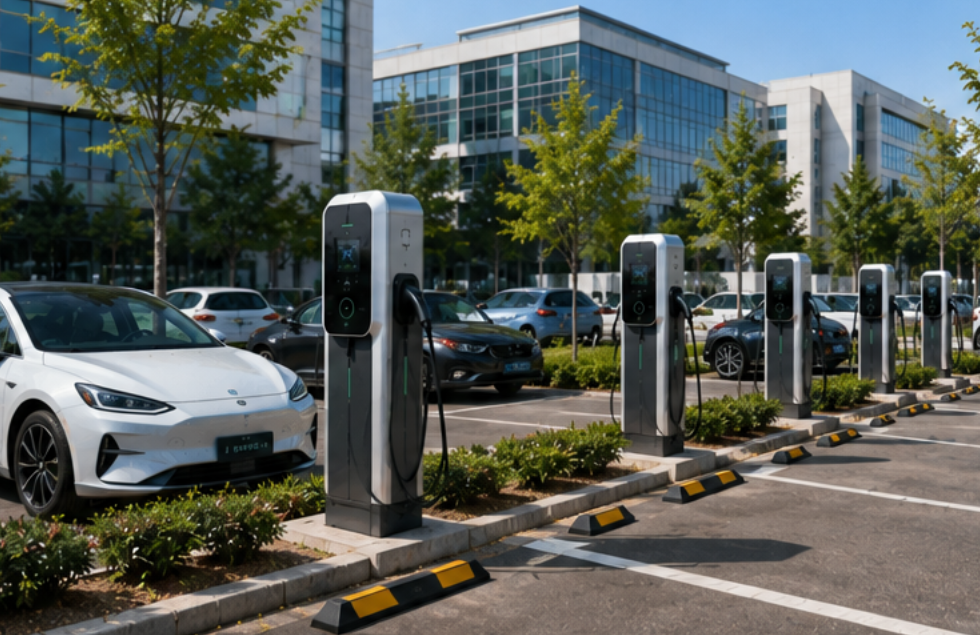
Pedestal chargers are often installed in visible outdoor parking areas, public spaces, commercial real estate, and transportation-related projects. In these environments, the charging station should not only look modern and charge vehicles well. It should also support practical daily operation. That means the charger must help the operator handle access, communication, remote control, and user interaction more efficiently.
Your brochure already shows this management direction clearly. Across AC, DC, and high-power pedestal charging solutions, the products support multiple smart functions such as RFID, app-based control, WiFi, 4G, OCPP communication, remote billing, and access control. These are exactly the functions that help charging projects move from basic hardware installation to real operating management.
| Function | Main Benefit | Best Management Use |
|---|---|---|
| RFID | Controls who can start charging | Employee charging, public access management, operator control |
| App Control | Supports user operation and operator-side control | Remote charging control, billing, user interaction, project monitoring |
| 4G Connectivity | Keeps the charger connected in outdoor or distributed sites | Remote sites, public charging, commercial parking, fleet projects |
2. How RFID Improves Pedestal EV Charger Management
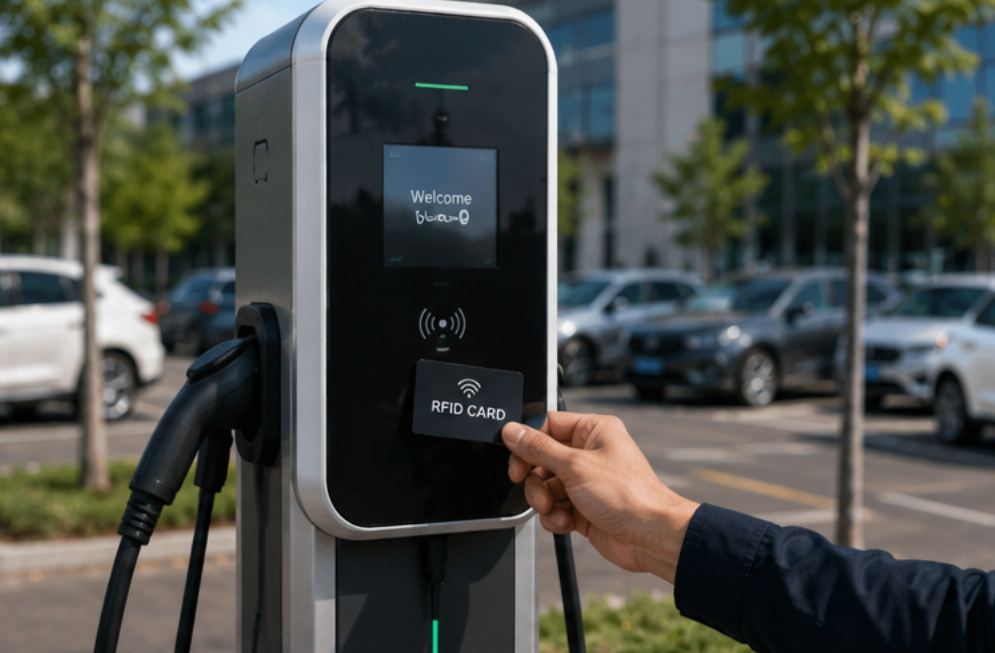
RFID is one of the simplest and most practical ways to improve charger access control. In public or commercial charging projects, not every driver should necessarily use every charger in the same way. Some sites want staff-only access. Others want tenant access, paid public access, or time-based control. RFID makes this easier by giving site operators a more structured way to decide who can activate charging.
This is useful because it reduces dependence on unmanaged walk-up charging. Instead of treating the charger as an open socket, RFID allows it to behave more like a managed service point. That improves order, helps control electricity use, and can support different levels of charging permission across the site.
Your brochure already lists RFID among the supported charging and access methods across the charging station range, including AC and DC solutions. In the AC product specifications, RFID is linked with access control, while higher-power models also include RFID among their supported charging methods.
3. How App Control Improves Charging Operation
App control improves pedestal EV charging management by making the charger easier to operate and easier to supervise. For the user, app-based interaction can make charging more convenient and more modern. For the site operator, it can support remote management, charging control, usage visibility, and a smoother operating process than manual on-site handling.
This matters most in projects where the charger is part of a broader service model. Public charging, commercial parking, fleet operations, and outdoor fast-charging sites often need more than simple plug-in charging. They need a way to manage sessions, support billing, and coordinate charging across multiple users or multiple chargers. App control helps the charging station function more like a connected service platform instead of an isolated device.
The brochure explicitly shows this direction. The 30/40kW DC charging station includes app control, and the 240kW DC charging station supports APP remote billing, payment, intelligent control, and APP charging control. These features make pedestal charging much more suitable for commercial-scale management.
4. How 4G Improves Outdoor And Distributed Charger Management
4G connectivity is especially valuable in pedestal EV charging projects because many chargers are installed outdoors, across open parking areas, roadside locations, or sites where fixed network conditions may not always be convenient. In these projects, strong communication is essential if the operator wants to monitor charger status, control charging remotely, support smart services, and keep the charger connected as part of a larger system.
A charger without reliable communication becomes much harder to manage at scale. That is why 4G matters. It gives the charging project more freedom in site selection and makes it easier to connect chargers in public spaces, commercial parking, and transportation-related environments where remote access and network flexibility matter.
Your brochure repeatedly highlights this point. The 7–22kW AC charging station supports WiFi and 4G access, the 30/40kW DC charging station supports WiFi and 4G, and the 240kW DC charging station supports Ethernet and 4G access. This makes it clear that connectivity is treated as a core management feature, not a secondary extra.
For pedestal chargers in outdoor and public environments, 4G is one of the key features that helps the charging station stay manageable after installation.
Conclusion
RFID, app control, and 4G improve pedestal EV charging station management because they solve three core operating problems: access, control, and connectivity. RFID helps define who can use the charger. App control helps manage charging, user interaction, and commercial operation. 4G helps keep the charger connected and manageable in outdoor and distributed sites. Together, these functions make pedestal EV chargers far more suitable for real commercial and public charging projects.
Contact Us
Looking for a smarter pedestal EV charging solution for your site? Contact our team to discuss RFID, app control, 4G connectivity, and the right charging configuration for your project.