How To Evaluate Smart Meter Components Before Mass Production Starts
How To Evaluate Smart Meter Components Before Mass Production Starts
Before mass production starts, smart meter components should be evaluated from a full system perspective rather than only by checking sample specifications. A component that performs well in early validation may still create hidden risks in large-scale production or long-term field use if its electrical stability, thermal behavior, dimensional consistency, insulation reliability, or manufacturing repeatability are not verified carefully. This guide explains how to evaluate smart meter components more practically before production launch and what project teams should focus on to reduce failure risk and improve long-term product stability.
1. Why Component Evaluation Matters Before Production Launch
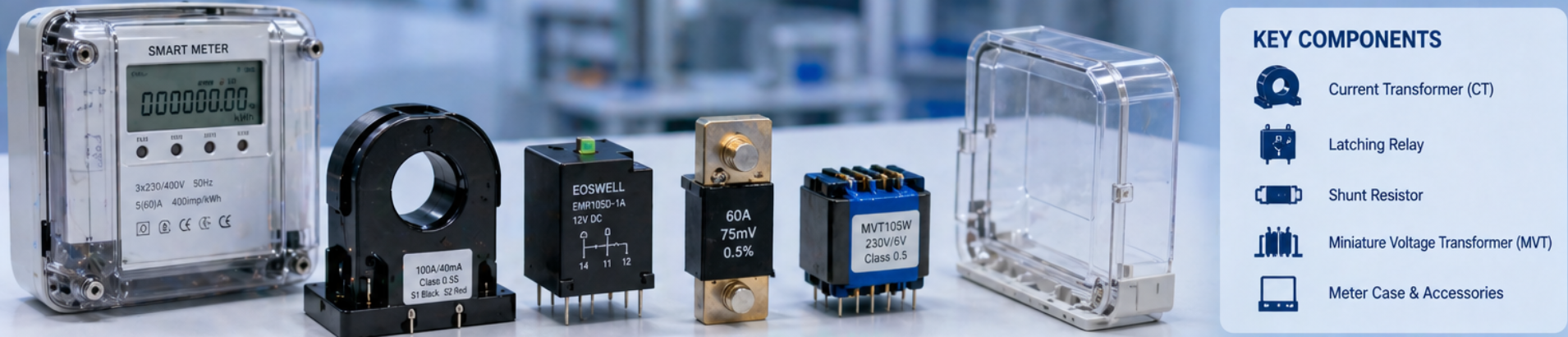
In a smart meter project, the final product performance depends on how multiple key parts work together rather than how one component performs alone. Current transformers, miniature voltage transformers, latching relays, shunt resistors, meter cases, and supporting assemblies all influence the meter’s accuracy, safety, reliability, and production stability. If one part is selected only by basic specification without deeper evaluation, the entire meter may face problems later in calibration, assembly, long-term field use, or warranty control.
Many teams focus first on whether a sample can pass a basic functional check. That is necessary, but it is not enough before mass production begins. A component may appear acceptable in a small prototype run and still create risk later if it shows too much thermal drift, unstable batch consistency, weak insulation behavior, contact wear, structural tolerance variation, or sensitivity to real operating conditions. Pre-production evaluation is the stage where these hidden weaknesses should be identified and controlled.
This is particularly important in smart meters because the product is expected to operate for years in practical environments where temperature change, electrical stress, humidity, dust, and repeated switching or sensing conditions are unavoidable. If the core parts are not evaluated under realistic conditions before launch, production may begin with risks that are difficult and expensive to correct later.
The goal of evaluation before mass production is therefore not only to prove that the component works once. It is to confirm that the component can remain stable, repeatable, and compatible with the full smart meter system across volume production and long-term field operation.
2. What Should Be Checked Before Mass Production Starts
The first area to review is electrical performance stability. For sensing and metering parts such as current transformers, miniature voltage transformers, and shunt resistors, teams should confirm that the component behaves predictably across the intended operating range rather than only at one nominal point. Ratio behavior, repeatability, low-current response, burden compatibility, and consistency under realistic circuit conditions should all be reviewed carefully. For latching relays, switching behavior, pulse actuation consistency, and contact reliability deserve the same level of attention.
The second area is thermal behavior. Smart meters are compact devices, and heat influence can affect both sensing accuracy and structural reliability. Components should be checked for temperature rise, performance stability under changing ambient conditions, and whether they create additional stress on surrounding parts. A component that performs well only at room temperature may still create problems later in real use.
The third area is insulation and safety structure. This is especially important for current transformers, miniature voltage transformers, relays, and meter housings. The component should support the overall electrical safety concept of the smart meter and remain stable under practical operating conditions. Safety-related evaluation is not only about passing one check. It is about whether the part supports stable, long-term confidence in the final product.
The fourth area is dimensional fit and assembly compatibility. A component may have good electrical performance but still create production risk if it does not fit the PCB, enclosure, terminal structure, or automated assembly process consistently. This is particularly important for meter cases, relays, CTs, and transformers where height, mounting precision, and tolerance control can affect production efficiency and overall product stability.
The fifth area is environmental and durability performance. Depending on the smart meter application, components may need to withstand humidity, dust, temperature cycling, repeated operation, or long-term exposure in outdoor or semi-outdoor conditions. Pre-production evaluation should therefore include durability thinking, not just initial function.
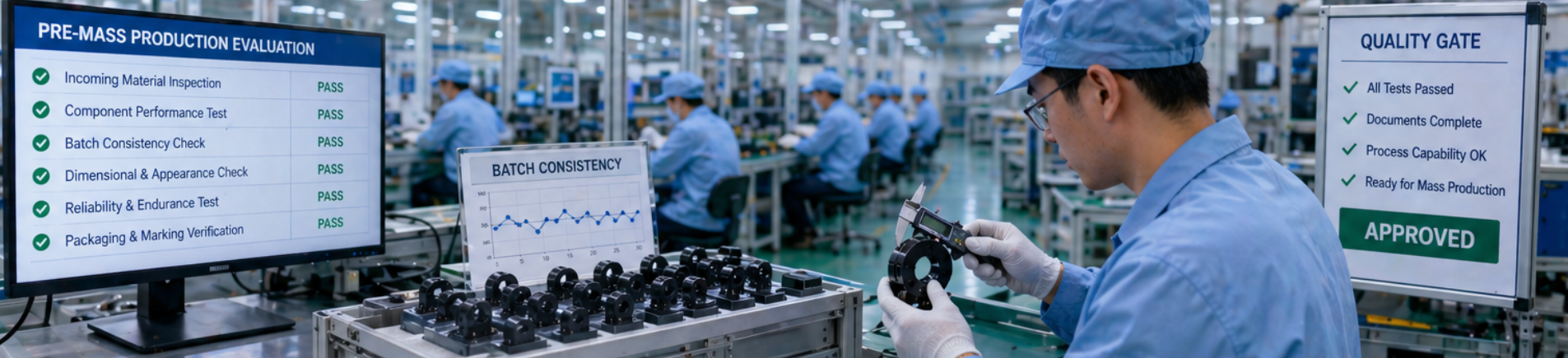
Finally, batch consistency should be reviewed before volume release. It is not enough to validate only one excellent sample. Teams should compare multiple units and verify whether the supplier can maintain stable quality across repeated production. In mass production, repeatability often matters just as much as the original design.

| Evaluation Area | Why It Matters | What To Review |
|---|---|---|
| Electrical Stability | Supports accurate and predictable smart meter behavior | Signal consistency, repeatability, circuit compatibility, switching stability |
| Thermal Performance | Reduces drift risk and long-term instability | Temperature rise, thermal drift, stability under changing conditions |
| Insulation / Safety | Protects the meter and supports reliable field use | Isolation behavior, structural safety, application fit |
| Dimensional / Assembly Fit | Improves manufacturability and reduces assembly variation | PCB fit, tolerance control, mounting precision, housing compatibility |
| Environmental / Durability Performance | Helps prevent hidden field reliability issues | Humidity resistance, cycling behavior, repeated operation, long-term stability |
| Batch Consistency | Supports stable calibration and smooth mass production | Unit-to-unit repeatability, process control, inspection stability |
3. How To Build A More Practical Evaluation Process
A stronger evaluation process starts with the real smart meter application rather than a generic checklist alone. Project teams should first define the operating environment, expected service life, electrical load condition, enclosure temperature profile, and installation scenario. Once those conditions are clear, it becomes easier to judge whether each component is truly ready for mass production or only looks acceptable in limited sample testing.
It is also important to evaluate components at the system level. A current transformer, relay, shunt resistor, miniature voltage transformer, or meter case may pass standalone tests and still create problems when combined in the final smart meter design. System-level review helps reveal issues related to heat buildup, layout interaction, burden mismatch, actuation control, assembly tolerance, and enclosure stress before production starts.
Another practical step is to compare not only initial performance but also post-stress performance. In other words, the question should not only be whether the component still works after testing, but whether its key electrical and structural behavior remains stable afterward. This is where hidden risk often appears, especially in high-volume smart meter programs.
Supplier capability should also be part of the evaluation. A supplier with real laboratory support, production control, and repeatable quality is much more likely to support smooth mass production than one that provides only a good early sample. Before launch, teams should confirm whether the supplier can maintain the same stability level across repeated batch deliveries.
The best pre-production evaluation process is therefore one that combines electrical, thermal, safety, dimensional, environmental, and consistency checks in a way that reflects the real smart meter application. This kind of evaluation helps reduce uncertainty before mass production and builds much stronger confidence in the final product.
Conclusion
Evaluating smart meter components before mass production starts requires more than confirming that the sample works once. The right evaluation process should verify electrical stability, thermal behavior, safety support, dimensional compatibility, environmental durability, and batch consistency under realistic smart meter conditions. When these checks are carried out together and linked to the real application, project teams can reduce launch risk, improve manufacturing confidence, and support stronger long-term product reliability.
Contact Us
Looking for reliable smart meter components with stable testing and production support? Contact our team to discuss component selection, validation strategy, and supply capability.