What Buyers Should Know About DC Immunity In Metering Current Transformers
What Buyers Should Know About DC Immunity In Metering Current Transformers
In metering applications, DC immunity is not just a technical term in a product description. It can have a real influence on measurement stability, long-term accuracy, calibration behavior, and application reliability when the current transformer works in more demanding electrical conditions. Buyers who understand DC immunity are better prepared to choose the right metering CT, reduce hidden error risk, and improve smart meter performance over time. This guide explains what DC immunity means in practical terms and what buyers should pay attention to before selection.
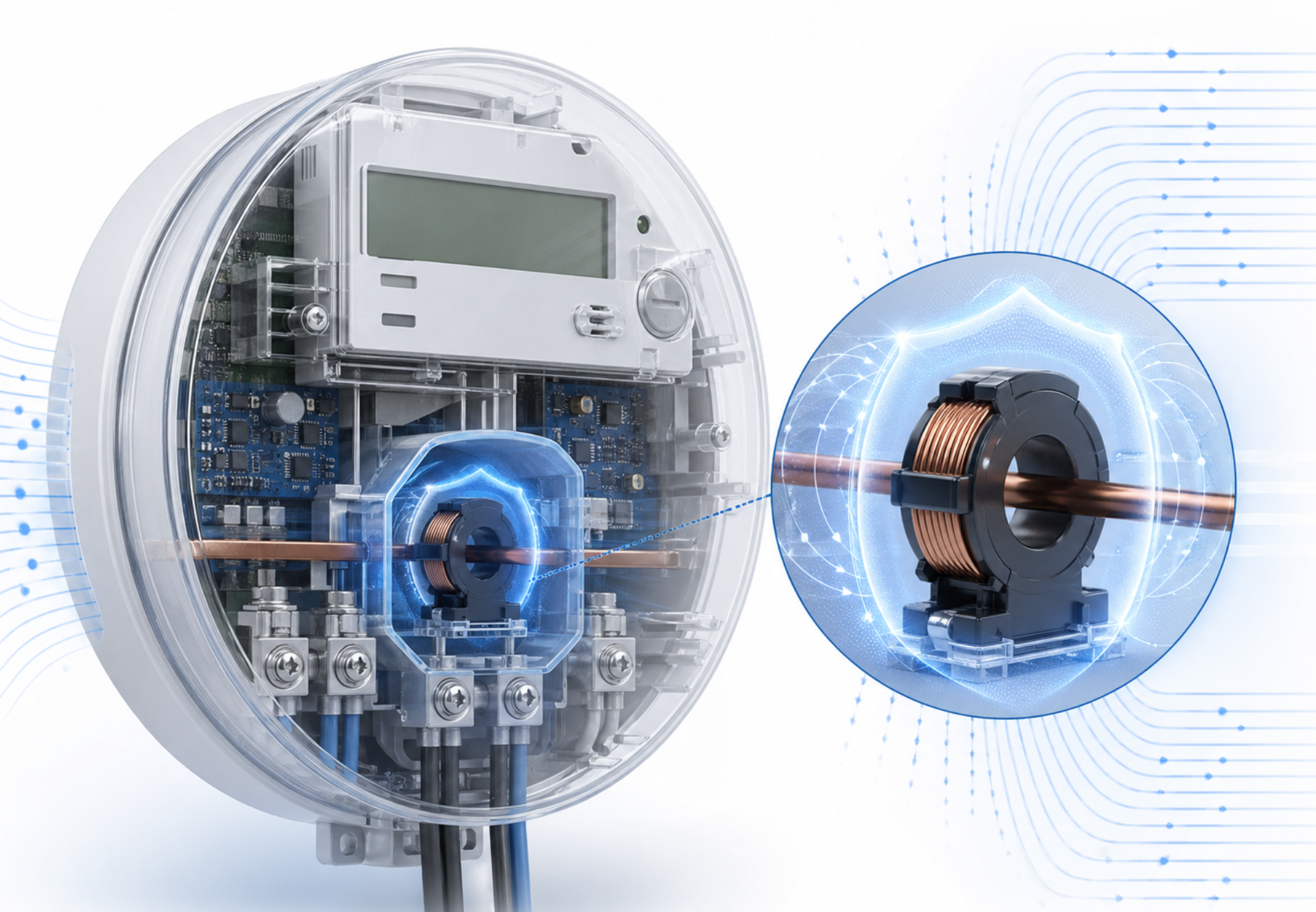
1. What DC Immunity Means In A Metering Current Transformer
A metering current transformer is normally designed to convert alternating current into a usable secondary signal for the smart meter circuit. In practice, however, some electrical environments are not perfectly ideal. Under certain conditions, DC-related influence can affect the magnetic behavior of the CT and disturb the way it responds to AC current measurement. When this happens, the output may become less predictable and the meter may face higher measurement risk.
DC immunity refers to the ability of the metering CT to resist this type of unwanted influence and maintain more stable measurement behavior. It does not mean the CT suddenly becomes a general-purpose DC sensor. Instead, it means the CT is better able to keep its AC metering performance from being disturbed by DC-related magnetic bias or other non-ideal conditions that may appear in practical applications.
For buyers, the key point is simple: DC immunity is about protecting measurement stability in the real world. A smart meter may perform well under controlled conditions, but once it is used in more demanding systems, hidden factors can affect CT behavior. A metering CT with stronger DC immunity can help reduce this risk and support more dependable performance over time.
That is why DC immunity should not be viewed as a decorative specification. For the right application, it can be an important part of choosing a more reliable metering component.
2. Why Buyers Should Care About DC Immunity Before Ordering
The first reason is measurement stability. In metering applications, even a small disturbance in CT behavior can affect the final output quality of the smart meter. If the current transformer is vulnerable to DC-related influence, the result may be reduced stability across the working range, weaker low-current performance, or higher risk of deviation during actual use. A CT with stronger DC immunity helps reduce that risk and supports a more predictable metering path.
The second reason is calibration and production efficiency. Buyers do not only need a CT that works in one engineering sample. They need one that behaves consistently across volume production. If the CT is more sensitive to magnetic disturbance, the meter may require more calibration effort or tighter production control to maintain the target result. A more stable DC-immune design can help reduce that hidden pressure.
The third reason is long-term reliability. Smart meters are often expected to operate for years in practical environments. Over time, hidden measurement instability can become a field risk even if the product passed basic validation at the beginning. Buyers should therefore think beyond the initial sample result and consider whether the CT can continue supporting stable meter performance in the real operating environment.
Another important reason is application fit. Not every metering project needs the same CT structure or the same robustness level. But when the application environment is more demanding, DC immunity becomes much more relevant. Buyers who understand that can make better decisions instead of comparing parts only by current rating or basic size.
In short, DC immunity is valuable because it helps connect component selection with real application reliability. That is exactly the kind of issue buyers should care about before placing volume orders.

| Buyer Check Point | Why It Matters | What To Review |
|---|---|---|
| Application Environment | Determines whether DC immunity is especially important | Metering scenario, system conditions, expected operating stress |
| Metering Stability | Supports more reliable long-term measurement performance | Low-current behavior, repeatability, stability trend |
| Calibration Impact | Affects production efficiency and consistency | Ease of calibration, output predictability, batch behavior |
| Thermal / Long-Term Stability | Helps reduce hidden field drift risk | Temperature behavior, long-term consistency, reliability trend |
| Supplier Capability | Supports repeatable quality in volume orders | Process control, inspection repeatability, batch stability |
| System Fit | Ensures the CT supports the full smart meter design | Burden condition, PCB fit, metering path compatibility |
3. How Buyers Can Evaluate DC Immunity More Effectively
The most practical way is to begin with the real smart meter application instead of starting from the catalog alone. Buyers should first understand the intended use environment, system conditions, accuracy target, and long-term reliability expectations. Once those factors are clear, it becomes much easier to determine whether DC immunity is an important selection requirement rather than a secondary feature.
It is also useful to ask for validation that goes beyond a single sample description. A strong buying decision should include practical performance review, repeated sample comparison, and application-oriented evaluation. This helps buyers understand whether the CT can remain stable not only in theory, but also under realistic operating conditions and across production batches.
Buyers should also review the supplier’s product positioning and production control. A supplier that already offers dedicated metering CTs with DC immunity and stable manufacturing support is usually in a better position to help with long-term project reliability. This is especially important in volume smart meter programs where repeatability matters as much as initial performance.
Another useful principle is to avoid over-focusing on only one parameter such as current rating or basic size. A CT may look suitable on paper but still create hidden risk if its stability, burden compatibility, or long-term consistency is weak. The better buying decision comes from balancing several factors that support real metering reliability together.
In the end, buyers should think of DC immunity as part of practical component robustness. When chosen correctly, it can help the smart meter remain more accurate, more stable, and more reliable across production and field use.

Conclusion
Buyers should know that DC immunity in metering current transformers is not just a technical extra. In the right application, it can play an important role in protecting measurement stability, improving calibration consistency, and reducing long-term reliability risk. The better buying decision comes from checking how the CT performs in real smart meter conditions, whether the supplier can maintain repeatable quality, and whether the component supports the full metering system instead of only meeting a basic catalog description.
Contact Us
Looking for the right metering current transformer for your smart meter project? Contact our team to discuss DC immunity, application matching, and stable supply support.