How To Prevent Accuracy Drift In Smart Meter Current Transformer Selection
How To Prevent Accuracy Drift In Smart Meter Current Transformer Selection
In smart meter applications, current transformer selection has a direct influence on whether the meter can maintain stable accuracy over time. A CT that looks acceptable during early testing may still create long-term drift if its ratio behavior, linearity, burden response, thermal stability, or production consistency is not well matched to the real meter design. This guide explains how to prevent accuracy drift by choosing a current transformer that remains stable not only in sample validation, but also in mass production and field operation.
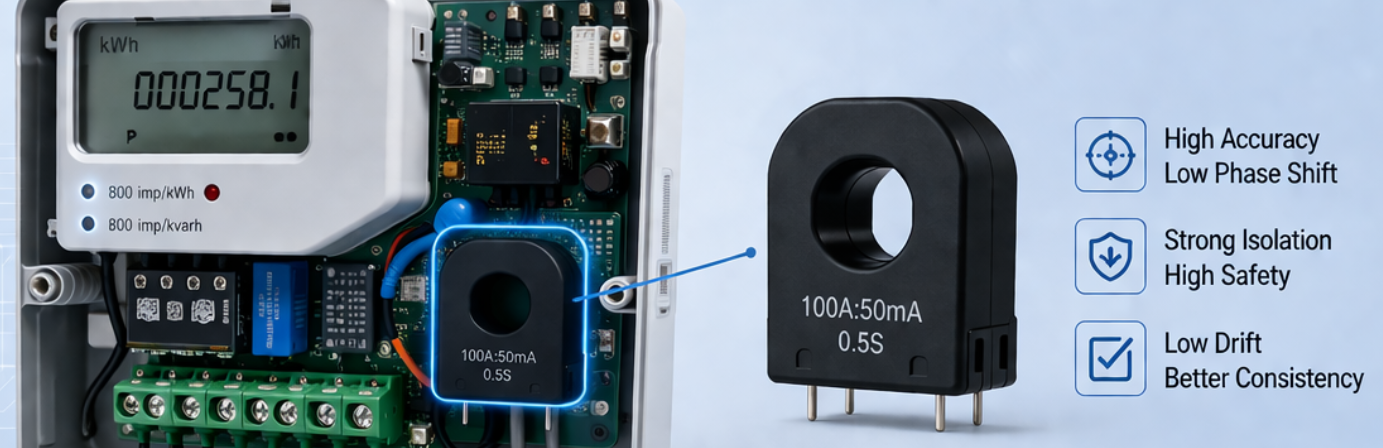
1. Why Accuracy Drift Happens In Smart Meter CT Applications
Accuracy drift in a smart meter usually does not come from one obvious problem at the beginning. More often, it develops gradually when the current transformer is not fully matched to the electrical, thermal, or production conditions of the final product. A CT may perform well in an ideal sample test and still become less stable later if its output changes too much with temperature, if the burden condition is not well controlled, or if unit-to-unit consistency is weak in mass production.
In a smart meter, the CT is part of the main measurement path. If its behavior shifts over time, the final meter may show increasing deviation at low current points, less predictable calibration behavior, or more variation between batches. These issues can be difficult to detect in the earliest project phase because the meter may still appear functional. The real problem appears later when production volume increases or when the product has been operating in practical environments for a longer period.
Another reason drift happens is that smart meters do not operate under one fixed condition. They may face changing loads, changing ambient temperature, different installation environments, and long service periods. A CT that is selected only by nominal current or one basic specification point may not remain stable enough under these real conditions. Preventing accuracy drift therefore begins with understanding how the CT will behave across the full intended operating range rather than only at a single reference point.
The goal is not simply to choose a CT that passes initial testing. The goal is to choose one that helps the smart meter keep predictable measurement performance throughout production, calibration, and long-term field use.
2. What To Check During CT Selection To Reduce Drift Risk
The first factor is ratio stability across the real operating range. The ratio should not only match the nominal current target, but also remain predictable at low current, normal working current, and other practical load points. If the ratio behavior changes too much across the range, the smart meter may become more difficult to calibrate and more vulnerable to long-term drift in use.
The second factor is linearity. A CT with good linearity helps the meter maintain smoother behavior as current changes rather than only working well at one calibration point. This matters because drift risk is often higher when the CT output does not follow input change in a stable and predictable way. Good linearity reduces compensation pressure and helps support stronger measurement consistency over time.
Burden matching is another major factor. The CT may appear accurate in a component-level test, but if the actual meter circuit applies a different burden condition, the output behavior may shift in ways that create hidden drift. Engineers should therefore review the complete metering path, including the metering IC input, any sensing elements, wiring effects, and secondary-side conditions, rather than evaluating the CT in isolation.
Temperature stability is equally important. Smart meters often work for years in environments where thermal conditions change over time. If the CT is sensitive to temperature-related drift, the final meter may gradually lose stability even when initial calibration looked acceptable. A current transformer with better thermal consistency can help reduce that long-term risk.
Mechanical and dimensional consistency should also be reviewed. Stable mounting, repeatable PCB fit, and controlled structural tolerance help ensure that the CT behaves more consistently from unit to unit. In large meter programs, small structural variation can contribute to larger measurement variation later.
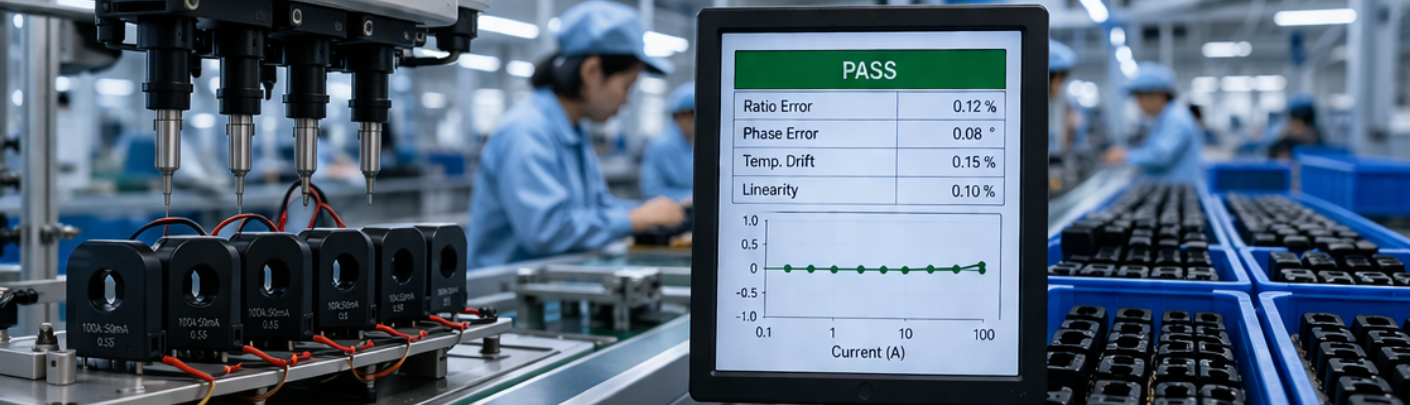
Finally, supplier process capability matters. A CT that performs well in a few samples may still create drift-related problems if mass-production control is weak. Stable core material control, winding consistency, and repeatable inspection are essential if the smart meter is expected to maintain accuracy across batch deliveries.

| Selection Factor | Why It Matters For Drift Prevention | What To Review |
|---|---|---|
| Ratio Stability | Helps keep signal conversion predictable over time | Behavior at low, normal, and higher current points |
| Linearity | Supports smooth output change and stable calibration behavior | Output consistency across the working range |
| Burden Matching | Reduces real-circuit deviation and hidden output shift | Secondary load condition, circuit compatibility, sensing path fit |
| Temperature Stability | Helps reduce long-term thermal drift risk | Thermal consistency, drift tendency, operating robustness |
| Mechanical / Dimensional Consistency | Improves integration repeatability and unit-to-unit stability | Mounting fit, PCB alignment, structural tolerance |
| Batch Quality Stability | Supports repeatable calibration and lower production variation | Core control, winding quality, inspection repeatability |
3. How To Evaluate Drift Risk More Practically Before Final Selection
The most effective way to prevent accuracy drift is to evaluate the CT in conditions that are as close as possible to the final smart meter design. That means reviewing performance with the real burden condition, actual metering path, expected calibration logic, and representative thermal environment. A CT that looks stable in isolation may still create drift once it is installed in the real meter system.
It is also important to compare performance before and after stress conditions such as temperature variation or repeated operating cycles. Drift prevention is not only about initial accuracy. It is about whether the CT keeps behaving in a similar way after practical stress has been introduced. This kind of validation often shows which component is better suited for real production and long-term field use.
Another useful step is to review supplier capability together with the technical specification. A metering CT becomes truly low-drift at the project level only when the supplier can maintain stable quality across repeated production. Engineers and buyers should therefore consider process control, inspection stability, and batch repeatability along with the component data sheet.
Project teams should also avoid relying on one headline claim alone. A part may show good nominal accuracy, but still create drift risk if its linearity, burden sensitivity, or thermal behavior is not well matched to the actual application. The strongest decision usually comes from evaluating several stability factors together.
In the end, preventing accuracy drift in smart meter CT selection means choosing a component that remains predictable, repeatable, and well matched to the full metering system over time. That kind of CT selection leads to stronger long-term accuracy control and lower field risk.
Conclusion
Preventing accuracy drift in smart meter current transformer selection requires more than checking one nominal performance value. The right CT should support stable ratio behavior, good linearity, proper burden compatibility, reliable thermal performance, mechanical consistency, and repeatable batch quality. When these factors are evaluated together in the context of the real smart meter design, project teams can reduce drift risk, improve calibration stability, and build meters with stronger long-term measurement reliability.
Contact Us
Looking for the right current transformer for your smart meter project? Contact our team to discuss CT selection, application matching, and stable supply support.