What Drawings And Data Buyers Should Send Before Smart Meter RFQ
What Drawings And Data Buyers Should Send Before Smart Meter RFQ
In smart meter projects, an RFQ becomes much more useful when buyers send the right drawings and project data at the beginning. If the RFQ only includes a simple product name or a request for “best price,” suppliers usually have to guess the application, structure, and performance expectation. That often leads to rough quotations, unsuitable sample recommendations, and repeated revisions later. This guide explains what drawings and data buyers should send before a smart meter RFQ so the quotation can be faster, more accurate, and more useful for real project decisions.
1. Why Smart Meter RFQs Often Become Slow And Inaccurate
In many sourcing cases, buyers begin with a short request such as “Please quote current transformer for smart meter” or “Need latching relay for meter project.” While this is enough to start a conversation, it is usually not enough to produce a reliable quotation. Smart meter components are closely linked to the real design, and even small differences in layout, mounting method, operating range, or safety expectations can change the recommended model and the quotation logic.
A current transformer may need a different mounting structure depending on whether it is fixed on PCB or on the meter bottom case. A relay may need to match a specific load control logic and pulse condition. A shunt resistor may depend heavily on layout and thermal structure. A miniature voltage transformer or meter case may also require exact dimensional information before the supplier can recommend the right path. If these details are missing, the supplier can only provide a general commercial reply instead of a project-ready RFQ response.
This is why a stronger RFQ begins with stronger project information. The better the drawings and data buyers provide, the less likely the quotation is to be revised later. It also improves sample relevance and reduces the risk of choosing a part that only looks suitable in theory.
A good RFQ is not longer because it uses more words. It is better because it gives the supplier enough information to match the component to the real smart meter design.
2. What Drawings And Data Buyers Should Send Before RFQ
The first thing buyers should send is the basic project description. The supplier should know whether the project is for a single-phase smart meter, prepaid meter, ANSI meter, DIN rail meter, energy monitor, or another related application. This helps define the correct product path before technical details are reviewed.
The second thing is the main electrical data. Buyers should clearly provide rated current or voltage range, the intended metering function, and any known expectations related to measurement behavior, switching requirement, burden condition, or insulation target. Even when the final design is still under discussion, these basic electrical conditions are essential for a meaningful quotation.
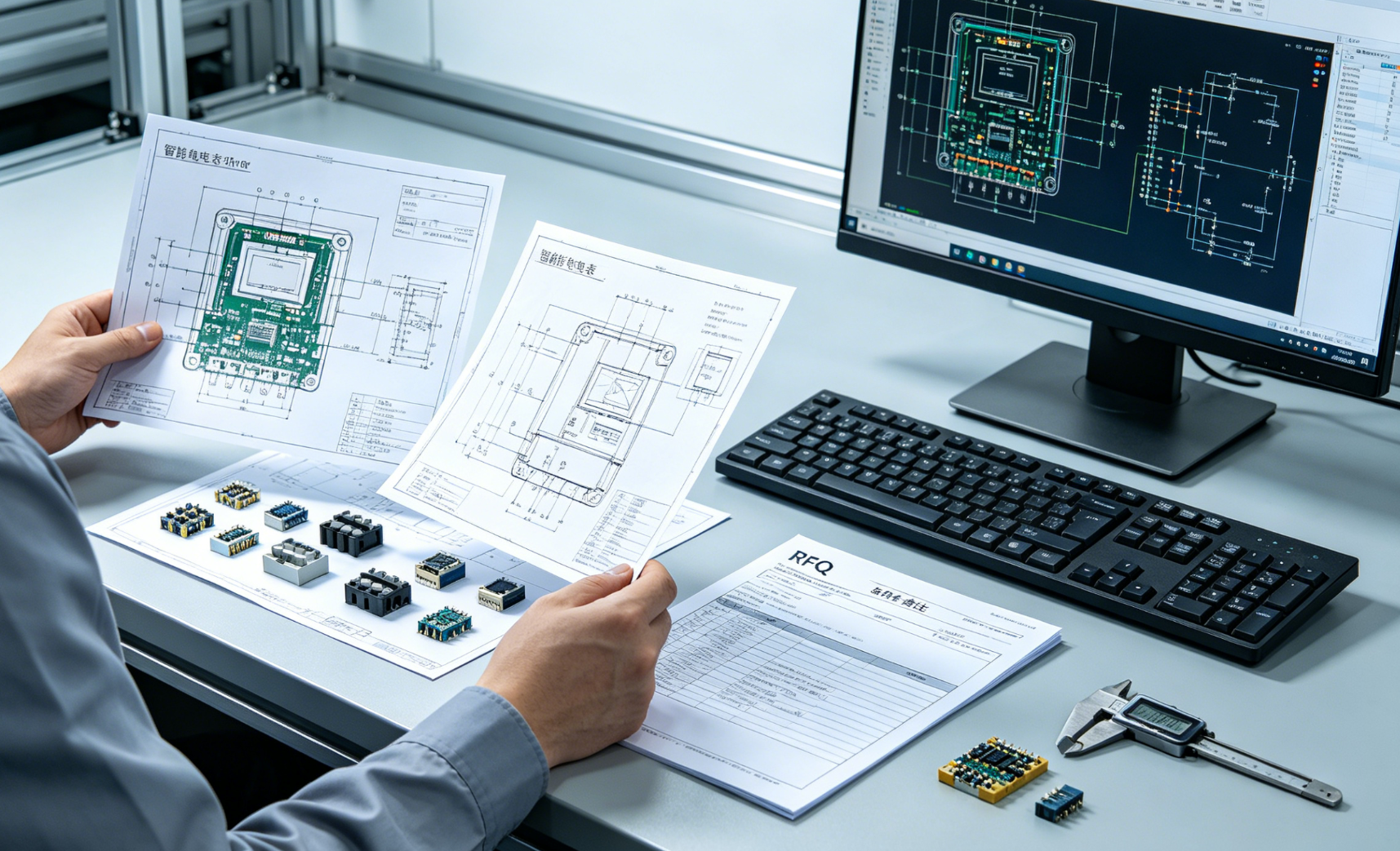
The third thing is the PCB layout or at least a simplified board drawing. This is especially important for current transformers, relays, shunts, and miniature voltage transformers. If the supplier can see the component location, hole positions, available height, and surrounding structure, they can judge much more accurately whether a standard model is suitable or whether dimensional changes will be needed.
The fourth thing is dimensional or structural drawings. Buyers should send the mechanical drawing, internal space limits, mounting direction, terminal arrangement, or enclosure-related dimensions whenever possible. If the smart meter project already has a case layout or internal stack-up drawing, that information is extremely useful because many component mismatches come from mechanical limits rather than purely electrical issues.
The fifth thing is photos or screenshots if full drawings are not yet ready. In many OEM projects, even a PCB photo, an internal assembly photo, or a sketch of the current path can help the supplier understand the project faster. A rough but relevant image is usually better than a very short text-only RFQ.
The sixth thing is project stage and quantity information. Buyers should say whether the RFQ is for first sample evaluation, pilot production, customer approval, or long-term OEM cooperation. Sample quantity, pilot quantity, and future annual demand affect quotation structure, sample relevance, and the recommended supply path.
Finally, buyers should mention any special concerns early, such as low-current stability, load control reliability, dimensional restrictions, ANSI structure fit, or long-term batch consistency expectations. This helps the supplier respond with a more realistic quotation rather than a basic catalog answer.
| RFQ Information Type | Why It Matters | Typical Example |
|---|---|---|
| Project Description | Defines the real smart meter application path | Single-phase meter, ANSI meter, prepaid meter, energy monitor |
| Electrical Data | Supports correct model recommendation and quoting | Rated current, voltage range, switching need, burden condition |
| PCB Layout | Prevents mounting and dimensional mismatch | Hole positions, component space, height limit, mounting location |
| Mechanical Drawings | Helps confirm structural fit before sampling | Internal space, case layout, terminal structure, stack-up drawing |
| Photos / Screenshots | Improves understanding when full drawings are not ready | PCB photo, assembly photo, wiring path image, project sketch |
| Project Stage / Quantity | Changes quotation logic and sample relevance | Sample stage, pilot stage, OEM stage, annual demand |
| Special Concerns | Helps the supplier focus on real risk points | Low-current accuracy, remote disconnect, ANSI fit, consistency |
3. How Buyers Can Prepare A Better RFQ Package
The most practical way is to organize the RFQ in layers. Buyers can start with a short project summary, then attach the most important electrical conditions, then send PCB or mechanical drawings, and finally add quantity expectations and any special concerns. This makes the RFQ easier for the supplier to understand and reduces the chance of missing important details.
It is also useful to separate confirmed information from flexible information. For example, buyers can state that the rated current and PCB location are fixed, while the final mounting direction or case size is still under discussion. This helps the supplier know which part of the quotation can be firm and which part may still need adjustment after sample review.
Buyers should also think of the RFQ as the first technical filter. A stronger supplier should respond to the drawings and data with relevant recommendations, not only with a general price. The way a supplier reacts to the RFQ often reveals whether they can support the project well beyond the first quotation stage.
Another useful principle is to avoid waiting for every drawing to become perfect before asking for a quote. A practical RFQ with enough real project information is often better than a very late RFQ with ideal documentation. What matters most is whether the supplier can understand the real design direction and respond in a way that helps the project move forward.
The best RFQ package is the one that helps the supplier quote more accurately, helps the buyer compare suppliers more clearly, and reduces the risk of repeated sample changes later.
Conclusion
Before sending a smart meter RFQ, buyers should prepare the key project drawings and technical data that define the real application, structure, and quotation path. PCB layouts, mechanical drawings, electrical conditions, photos, quantity plans, and special concerns all help the supplier recommend more suitable parts and provide more accurate quotations. In smart meter sourcing, better RFQ preparation usually leads to better samples, better quotes, and faster OEM progress.
Contact Us
Looking for reliable smart meter components for your OEM project? Contact our team to discuss drawings, samples, technical requirements, and quotation details.