What Information Should Buyers Provide Before Requesting A Smart Meter CT Quote
What Information Should Buyers Provide Before Requesting A Smart Meter CT Quote
When buyers ask for a smart meter current transformer quotation, the quality of the quotation depends heavily on the quality of the information they provide. If the request is too simple, the supplier may only be able to give a rough price range or a model recommendation that still needs to be revised later. If the request includes the right technical and project details, the quotation can be faster, more accurate, and more useful for sample selection, project comparison, and final purchasing decisions. This guide explains what buyers should provide before requesting a smart meter CT quote and how to reduce delays, rework, and quotation mismatch.
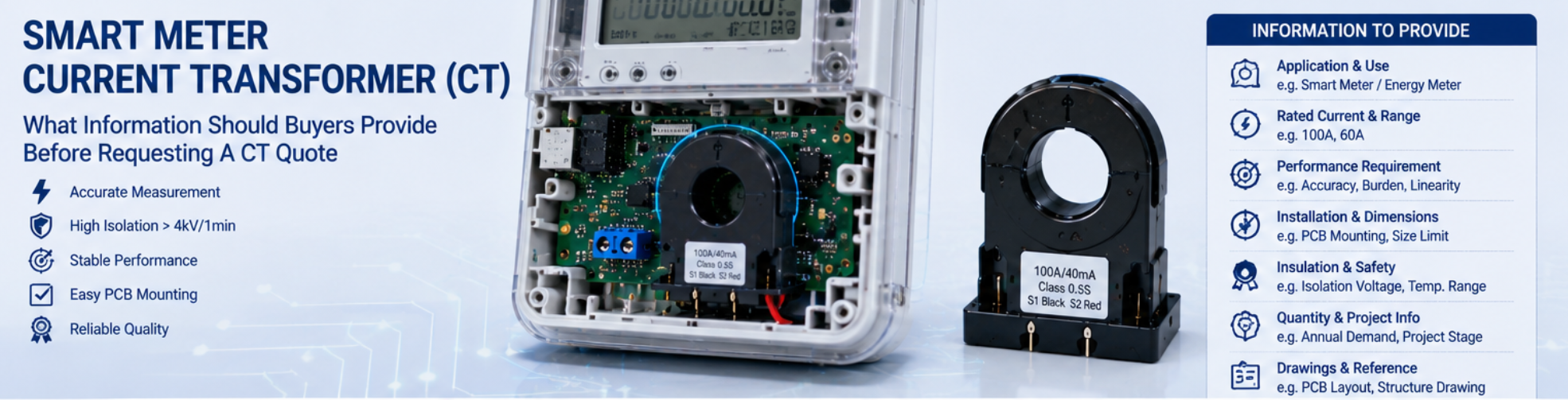
1. Why A Smart Meter CT Quote Can Be Wrong Or Incomplete
In many sourcing situations, buyers send only a short message such as “Please quote current transformer for smart meter” or “Need CT for meter project.” While this may start the conversation, it is usually not enough to produce a reliable quotation. A current transformer is not selected by current rating alone. The final model, price, and production recommendation depend on the meter structure, electrical requirements, mounting method, insulation target, dimensional limits, and project stage.
When important details are missing, the supplier often has to make assumptions. Those assumptions may lead to a quotation that is too general, too conservative, or based on a model that later turns out not to fit the PCB, enclosure, burden condition, or performance goal. This creates extra rounds of communication, delays the sampling process, and can slow down the project even before technical evaluation begins.
A better quotation request saves time for both sides. It allows the supplier to recommend a more suitable CT structure, judge whether an existing model can be used, estimate tooling or customization needs earlier, and provide more accurate commercial terms. For buyers, this means fewer surprises later in sampling, testing, or mass production preparation.
In short, a good CT quotation starts with a good RFQ. The more clearly the application is defined, the more valuable the quotation becomes.
2. What Information Buyers Should Provide Before Requesting A Quote
The first thing buyers should provide is the basic application background. The supplier needs to know whether the CT will be used in a smart meter, prepaid meter, energy meter, monitoring device, or another metering-related product. Even if the product category sounds similar, the design priorities may be different. This affects model selection, mounting style, and performance recommendation.
The second key point is the electrical requirement. Buyers should state the rated current, expected current range, and if relevant, what level of measurement performance is expected from the CT. This helps the supplier judge whether a standard model is appropriate or whether a different ratio or structure should be considered. If the project has specific expectations for burden, accuracy behavior, or low-current performance, that should also be mentioned early.
The third point is the mechanical and installation requirement. Buyers should explain whether the CT will be fixed on PCB, mounted inside the meter bottom case, or integrated in another way. If there are size limits, hole spacing requirements, terminal style preferences, or enclosure restrictions, these details should be sent with drawings or photos whenever possible. Many quotation mismatches happen because the electrical requirement is clear but the mounting condition is not.
The fourth point is insulation and environmental expectation. If the project has requirements for insulation strength, operating temperature, safety margin, or long-term stability, these should be included in the request. A CT used in a stable indoor meter platform may be quoted differently from one used in a design requiring stronger operating robustness or more demanding reliability support.
The fifth point is the commercial and project information. Buyers should mention estimated order quantity, sample demand, target market, project stage, and expected delivery schedule. If the request is for prototype evaluation only, the supplier may recommend one path. If it is for an OEM project with future volume production, the quotation logic may be different. This information helps the supplier provide a quotation that is closer to the actual business situation.
Finally, buyers should send drawings, datasheets, or reference photos if available. Even a simple PCB photo, meter layout sketch, or current path image can help the supplier understand the design much faster and reduce unnecessary back-and-forth.

| Information Buyers Should Provide | Why It Matters | Typical Example |
|---|---|---|
| Application Type | Helps define the right CT structure and recommendation path | Single-phase smart meter / prepaid meter / energy monitor |
| Rated Current And Range | Supports ratio and model matching | 60A / 100A / 120A / expected operating range |
| Performance Expectation | Helps the supplier judge standard vs customized solution | Accuracy target / low-current behavior / burden condition |
| Mounting Method | Prevents model mismatch during installation | PCB mounting / bottom case mounting / terminal style |
| Dimension Limits | Avoids layout conflict and repeated redesign | Max height / hole spacing / window size / available space |
| Insulation / Environment Requirement | Supports safer and more suitable model recommendation | Insulation target / operating temperature / stability need |
| Quantity And Project Stage | Helps define quotation structure and supply plan | Prototype / pilot run / OEM project / annual demand |
| Reference Files | Improves quotation accuracy and speeds up communication | Drawing / PCB photo / datasheet / meter layout image |
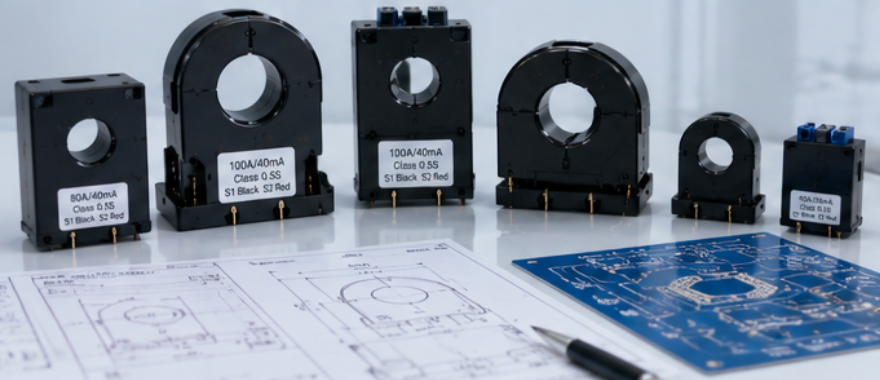
3. How Buyers Can Prepare A Better CT RFQ
The best RFQ is clear, structured, and close to the real project condition. Buyers do not need to send a long technical report, but they should provide enough information for the supplier to understand what kind of meter is being developed, what kind of CT is likely to fit, and whether the quotation should focus on a standard model or a customized solution. A short but complete RFQ is always better than a long but unclear one.
It is also useful to separate confirmed information from flexible information. For example, if the rated current and mounting direction are fixed, but the final hole spacing or output preference is still under discussion, that can be stated clearly. This helps the supplier know what can be quoted directly and what may still need engineering confirmation. That usually leads to faster and more practical feedback.
Buyers should also tell the supplier whether they mainly need price comparison, technical recommendation, sample support, or mass-production planning. A quotation request for sampling and technical evaluation is different from one intended for confirmed OEM procurement. Stating that purpose upfront helps the supplier respond in a more useful way instead of sending a generic commercial reply.
Another practical suggestion is to ask focused questions together with the quote request. For example, buyers can ask whether a standard model can meet the meter layout, whether stronger insulation is available, whether the supplier recommends PCB mounting or bottom-case mounting, or whether the sample is suitable for future batch production. These questions improve the value of the quotation and often shorten the decision cycle.
A better RFQ does not just get a faster price. It increases the chance of receiving a quotation that is technically useful, commercially realistic, and closer to the final project needs.

Conclusion
Buyers should provide clear application, electrical, dimensional, installation, safety, and project information before requesting a smart meter CT quote. Doing so helps the supplier recommend the right model faster, reduces repeated communication, improves quotation accuracy, and shortens the sampling and decision process. A better CT RFQ leads to a better quotation, and a better quotation usually leads to a smoother smart meter project.
Contact Us
Looking for the right current transformer for your smart meter project? Contact our team to discuss your application, drawings, sample needs, and quotation details.