What Reliability Tests Should Be Completed Before Smart Meter Component Mass Production
What Reliability Tests Should Be Completed Before Smart Meter Component Mass Production
Before smart meter components move into mass production, reliability testing should go far beyond a simple sample approval check. A component that looks acceptable in an early prototype can still create hidden problems later if its electrical stability, thermal behavior, insulation structure, dimensional consistency, environmental resistance, or batch repeatability have not been verified properly. This guide explains what reliability tests should be completed before smart meter component mass production and how buyers and engineers can reduce project risk before the production stage begins.
1. Why Reliability Testing Must Be Completed Before Mass Production
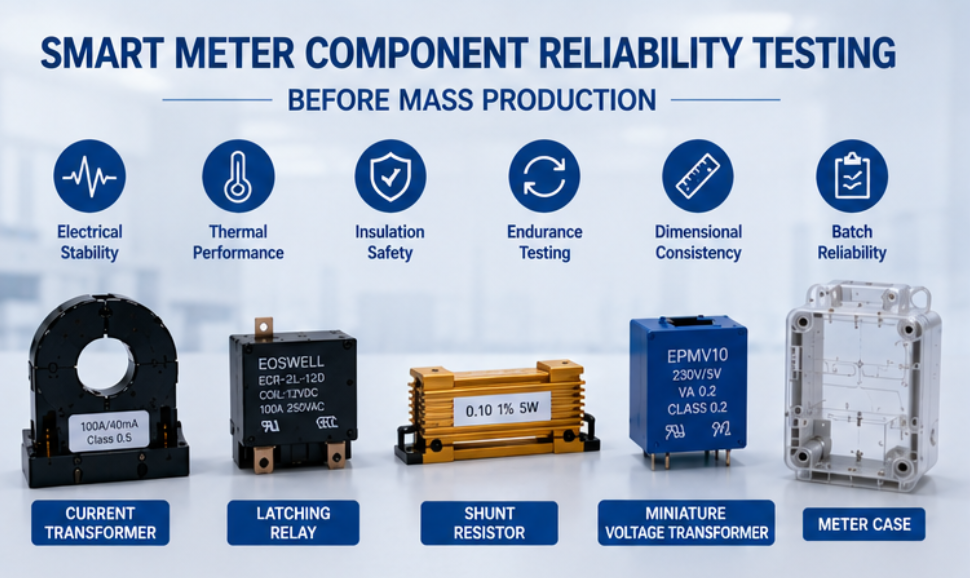
In smart meter projects, components do not fail only because of obvious defects. Many early field problems are caused by hidden weaknesses that were not discovered before production. A current transformer may show drift after thermal stress. A latching relay may become unstable after repeated switching. A shunt resistor may create more heat than expected. A miniature voltage transformer may show long-term inconsistency, and a meter case may create sealing or structural problems only after more realistic evaluation.
This is why reliability testing is not just a technical formality. It is the process that helps determine whether a component can remain stable under real working conditions and whether it can support mass production without creating hidden quality risk. If this step is skipped or treated too lightly, the project may still move forward, but the risk often appears later in calibration, assembly, incoming inspection, batch variation, or field use.
Reliability testing is especially important in smart meter products because the components usually operate in compact structures, with long service life expectations, and under changing thermal and electrical conditions. A part that survives one short test is not automatically ready for mass production. The real question is whether it can remain stable over repeated operation and across future production batches.
A better reliability test plan helps buyers and engineers reduce redesign, improve sample approval confidence, and enter production with fewer surprises.
2. What Reliability Tests Should Be Completed Before Mass Production
The first major group is electrical performance stability testing. For metering components such as current transformers, miniature voltage transformers, and shunt resistors, this means checking whether the component behaves predictably across the intended operating range rather than only at one nominal point. For latching relays, it means checking switching behavior, pulse actuation consistency, and functional stability under realistic conditions.
The second major group is thermal testing. Smart meters are compact products, so temperature rise and thermal drift can strongly influence long-term performance. Components should be reviewed for temperature rise, stability under changing thermal conditions, and whether they affect surrounding parts in the final design. A component that performs well only in a room-temperature bench test may still create problems later in real operation.
The third group is insulation and safety testing. This is especially important for current transformers, miniature voltage transformers, relays, and meter cases. The goal is to confirm whether the component supports the insulation structure and safety expectations of the smart meter design over time, not only during one initial sample check.
The fourth group is endurance and repeated-operation testing. For relays and other moving or stress-sensitive components, buyers should confirm whether the part remains stable after repeated use rather than only during the first cycles. For sensing parts and housings, endurance can also involve repeated stress conditions that reveal long-term weakness earlier.
The fifth group is dimensional and assembly consistency testing. A component may have good electrical performance and still create problems in mass production if it does not fit the PCB, case, terminal structure, or assembly process consistently. This matters a lot in smart meter OEM projects because structural mismatch often becomes a batch problem, not just a sample problem.
The sixth group is batch consistency validation. It is not enough to test only one good-looking sample. Buyers and engineers should compare multiple pieces and confirm whether the supplier can maintain stable material control, molding precision, winding quality, switching behavior, or inspection repeatability in future batches. This is one of the most practical reliability tests before mass production starts.
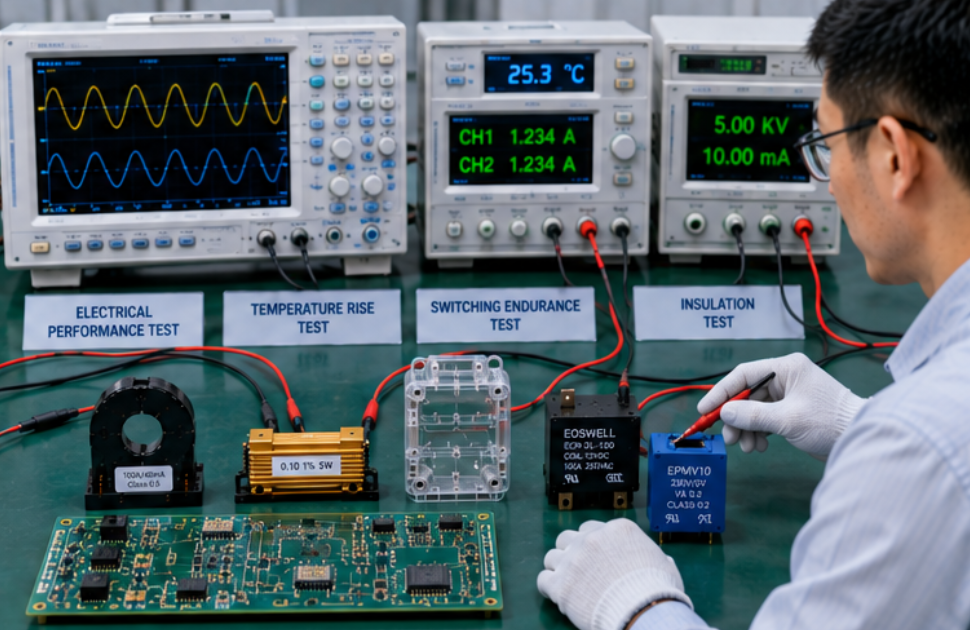
| Reliability Test Type | Why It Matters | What It Helps Confirm |
|---|---|---|
| Electrical Stability Test | Confirms predictable metering or switching behavior | Signal stability, burden fit, switching consistency, functional repeatability |
| Thermal Test | Reveals temperature-related drift and heat stress risk | Temperature rise, thermal stability, impact on surrounding components |
| Insulation / Safety Test | Improves long-term safety confidence | Insulation strength, structural safety, application reliability |
| Endurance / Repeated Operation Test | Shows whether the component remains stable over use cycles | Contact life, repeated switching performance, long-term behavior |
| Dimensional / Assembly Consistency Test | Prevents production mismatch and mounting problems | PCB fit, case fit, tolerance control, assembly repeatability |
| Batch Consistency Validation | Avoids sample-to-production quality gaps | Material stability, inspection repeatability, process control, unit-to-unit consistency |
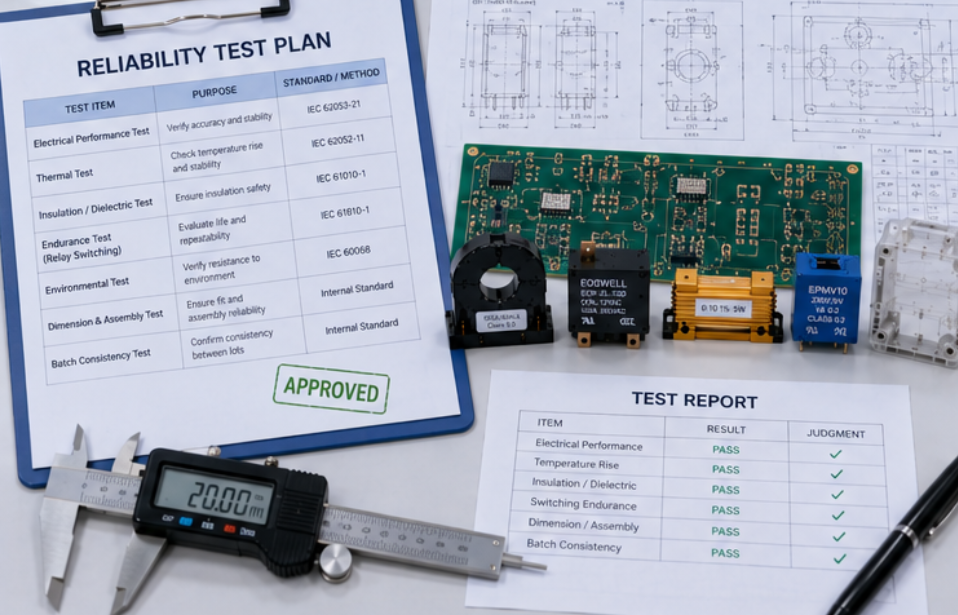
3. How To Build A Better Pre-Production Reliability Plan
The most practical way is to define the real project conditions before finalizing the test plan. Buyers and engineers should know the meter type, operating current or voltage range, thermal environment, installation concept, and target production stage. Once these are clear, reliability testing becomes much more meaningful because it reflects the real use case instead of a general laboratory exercise.
It is also important to evaluate the components together with the real smart meter design when possible. Testing a CT, relay, shunt resistor, miniature voltage transformer, or housing in isolation is useful, but system-level review is often what reveals the hidden risk. This is where burden mismatch, mounting issues, thermal accumulation, or structural interference become more visible.
Buyers should also separate early sample testing from production-readiness testing. A component may be good enough for a first prototype and still not be ready for volume supply. Reliability planning becomes much stronger when the project team clearly asks: does this sample only work, or is it also production-stable?
Another practical principle is to evaluate the supplier as part of the reliability plan. A supplier with better testing support, more stable process control, and clearer engineering feedback usually reduces future mass production risk much more effectively than one who only offers a low price or a quick first sample.
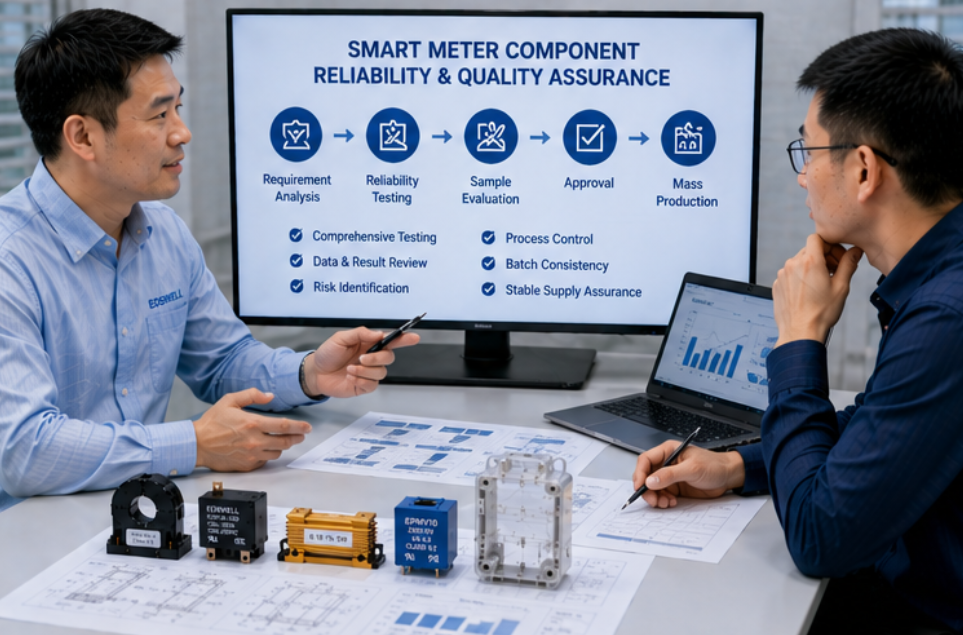
The best reliability test plan is the one that helps the smart meter project move into mass production with fewer hidden issues in quality, calibration, assembly, and long-term field performance.
Conclusion
Before smart meter component mass production begins, the most important reliability tests should confirm electrical stability, thermal behavior, insulation confidence, endurance under repeated use, dimensional consistency, and batch readiness. When these checks are completed together and linked to the real project conditions, buyers and engineers can reduce production risk and move forward with much stronger confidence in quality and long-term reliability.
Contact Us
Looking for reliable smart meter components for your OEM project? Contact our team to discuss drawings, samples, testing requirements, and quotation details.