Which Smart Meter Components Usually Cause Delays Before Mass Production
Which Smart Meter Components Usually Cause Delays Before Mass Production
In smart meter OEM projects, production delays often start long before the production line begins. The problem is usually not one single part failing completely, but one or more key components taking longer to confirm, test, approve, or stabilize for batch supply. Current transformers, latching relays, shunt resistors, miniature voltage transformers, and meter cases can all become delay points when the real application is not fully matched, the sample does not represent future production, or technical confirmation is completed too late. This guide explains which smart meter components usually cause delays before mass production and how buyers and engineers can reduce those delays earlier in the project.
1. Why Delays Usually Start At The Component Confirmation Stage
In many smart meter projects, the production schedule looks reasonable at the beginning. But once the project moves into sample review, drawing confirmation, PCB fitting, reliability testing, and batch planning, delays start to appear. This usually happens because some key components were selected too early, confirmed with incomplete information, or approved before the team had fully checked their real fit inside the final meter design.
A component can delay production even if it is technically “working.” For example, a current transformer may pass a basic sample test but still require more time because of burden matching, mounting direction, or low-current behavior. A relay may look fine on paper but need extra validation under real switching conditions. A meter case may look correct in appearance but still delay the project if the PCB, terminals, display window, and sealing structure are not fully aligned.
Another important reason is that different component categories create different types of delay. Some delay technical approval, some delay structural verification, and some delay batch consistency confirmation. This is why buyers and engineers should not ask only whether a part is available. They should ask whether the part is already ready for the next real project stage.
The most common delays happen when the team treats sample pass, technical fit, and mass-production readiness as if they were the same thing. In reality, they are not.
2. Which Components Usually Cause The Most Delays
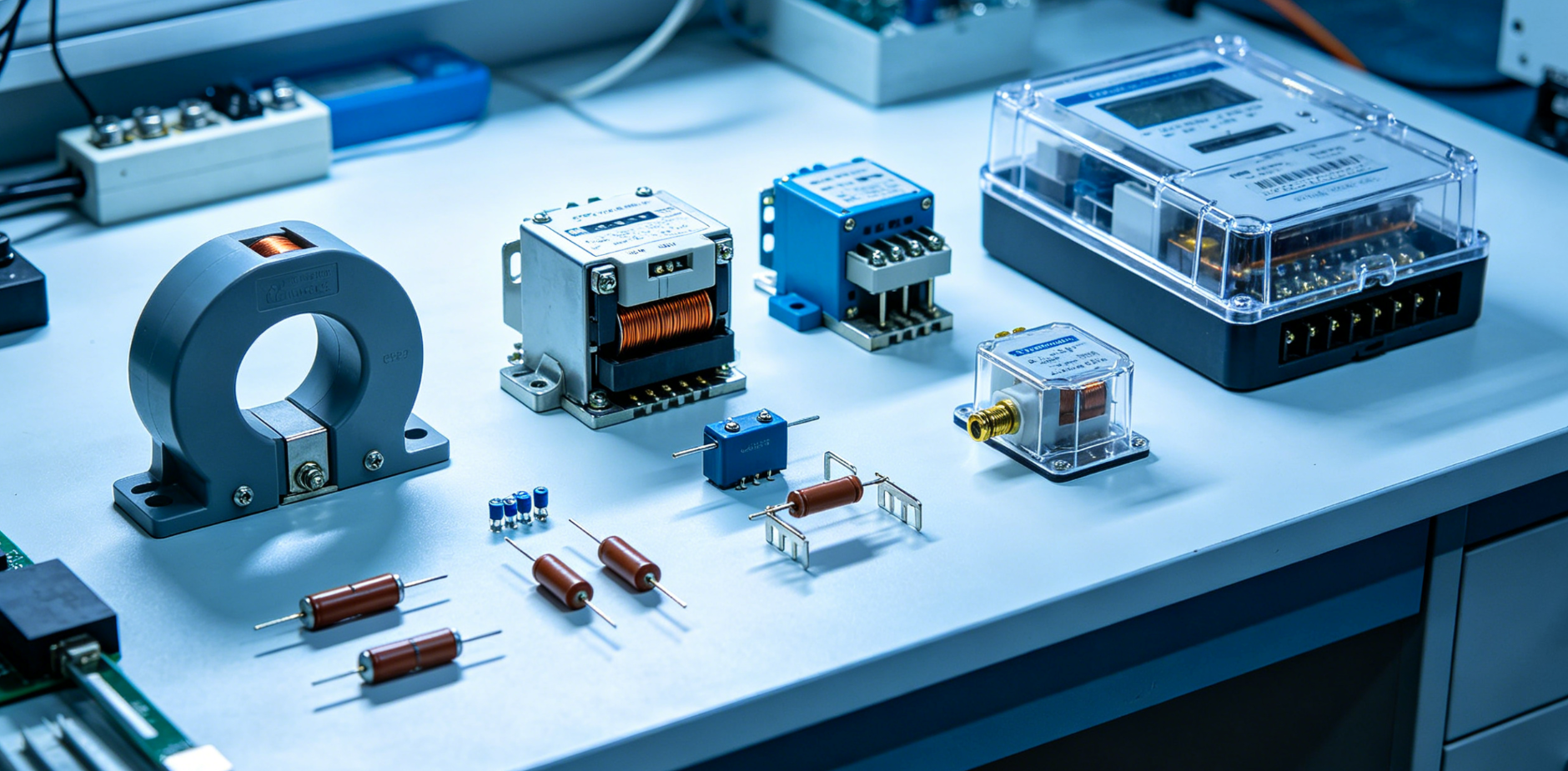
Current transformers are one of the most common delay sources because they are closely linked to accuracy, burden condition, mounting method, and PCB or case structure. A CT may look suitable during the first discussion and still need repeated confirmation once the real meter layout, current path, and production consistency requirements become clearer. If the sample does not fully match the actual design, the project may need more than one approval cycle before moving forward.
Latching relays are another common delay source, especially in smart meters with load control or remote disconnect functions. The relay may require additional checking for switching stability, pulse actuation consistency, thermal behavior, and long-term reliability. In many projects, the relay does not delay because it is unavailable, but because the team needs more confidence that it will remain stable under the real switching condition and future batch supply.
Meter cases can also delay production significantly. The case usually affects multiple parts at once, including PCB fit, terminal arrangement, CT and relay spacing, display structure, cover locking, and sealing confidence. If the housing is not fully matched to the internal design, the project may need drawing revision, sample re-check, or tooling-related re-evaluation. These delays are often more expensive than delays caused by small electrical parts.
Shunt resistors and miniature voltage transformers may also become delay points, especially when thermal behavior, dimensional fit, insulation expectation, or batch stability are not confirmed early. They are sometimes less visually obvious than relays or housings, but still create real schedule pressure if the project needs repeated validation before approval.
In short, the components most likely to delay mass production are usually the ones that sit at the intersection of performance, structure, and supply consistency.
| Component Type | Why It Delays The Project | What Should Be Confirmed Earlier |
|---|---|---|
| Current Transformer | Often needs repeated confirmation in accuracy path, burden fit, and structure | Operating range, burden condition, mounting method, PCB/case fit, batch consistency |
| Latching Relay | May require extra validation in switching, actuation, and repeated-use stability | Load control duty, pulse response, thermal behavior, production relevance |
| Meter Case | Affects multiple internal parts and can trigger structural rework | PCB fit, terminal layout, internal spacing, cover structure, sealing readiness |
| Shunt Resistor | Can delay approval when thermal and layout effects are underestimated | Thermal path, resistance fit, layout interaction, sample-to-batch stability |
| Miniature Voltage Transformer | May require more confirmation in output fit, insulation, and structure | Electrical fit, dimensional limits, insulation expectation, future supply path |
3. How Buyers And Engineers Can Reduce These Delays
The most practical way is to identify the likely delay parts early in the RFQ and sample stage. Buyers should provide the real meter type, rated current or voltage range, PCB layout, structural limits, and project stage before sampling. This helps the supplier recommend parts that are closer to the final design instead of only sending generally similar samples.
It is also useful to separate basic sample approval from production-readiness approval. A component may pass a first evaluation and still need more confirmation before it is safe to lock the batch path. When teams recognize this difference clearly, they usually avoid the common mistake of assuming that one good sample automatically means the part is production-ready.
Buyers should also compare suppliers by how well they support the difficult parts. A stronger supplier is not only the one who can send a sample quickly, but the one who can review drawings clearly, explain what still needs confirmation, and keep the same quality stable later. This reduces one of the biggest hidden causes of delay in OEM projects.
Another useful principle is to review components at the system level whenever possible. Delays often happen because the part is checked alone rather than as part of the full smart meter structure. PCB interaction, enclosure fit, heat buildup, terminal arrangement, and real operating conditions all matter much more than many teams expect in the early stage.
The best way to reduce production delays is to find the likely delay points before the schedule depends on them. That is what makes the whole OEM path smoother.
Conclusion
The smart meter components that usually cause delays before mass production are the ones that require deeper confirmation in electrical fit, structural fit, repeated-use stability, and future batch consistency. Current transformers, latching relays, and meter cases are often the most visible delay points, but shunt resistors and miniature voltage transformers can also slow the project when their real application conditions are not confirmed early. A stronger approval path reduces delay far more effectively than a faster but incomplete one.
Contact Us
Looking for reliable smart meter components for your OEM project? Contact our team to discuss drawings, samples, technical requirements, and quotation details.